
Key takeaways
- Heidi Klum's 2026 Halloween costume was a lifelike severed hand featuring her actual veins, engagement ring, wedding band, and vampy berry manicure, with her face emerging from the wound.
- Prosthetics designer Mike Marino constructed the hand from lightweight foam and latex weighing 8-10 pounds, incorporating mechanical systems Klum controlled from inside to create organic movement.
- Marino sculpted two distinct layers for the face: one showing internal anatomy and another with a goofy expression he described as a "mutant muppet" to balance horror with comedy.
- Klum and her team began planning immediately after Halloween 2025, continuing her 25-year tradition of never repeating a costume design.
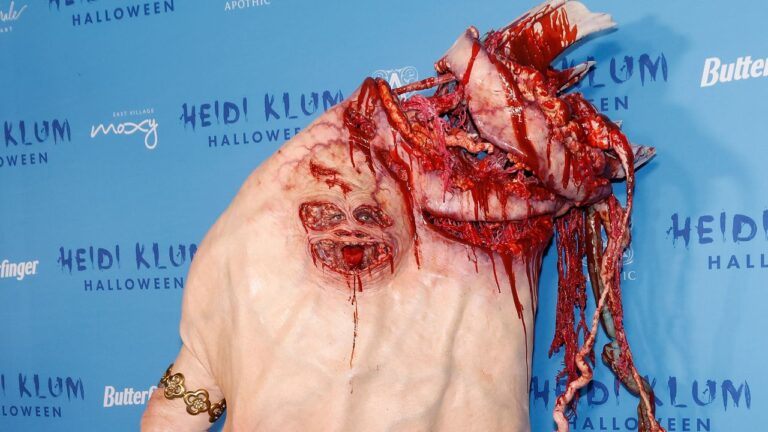
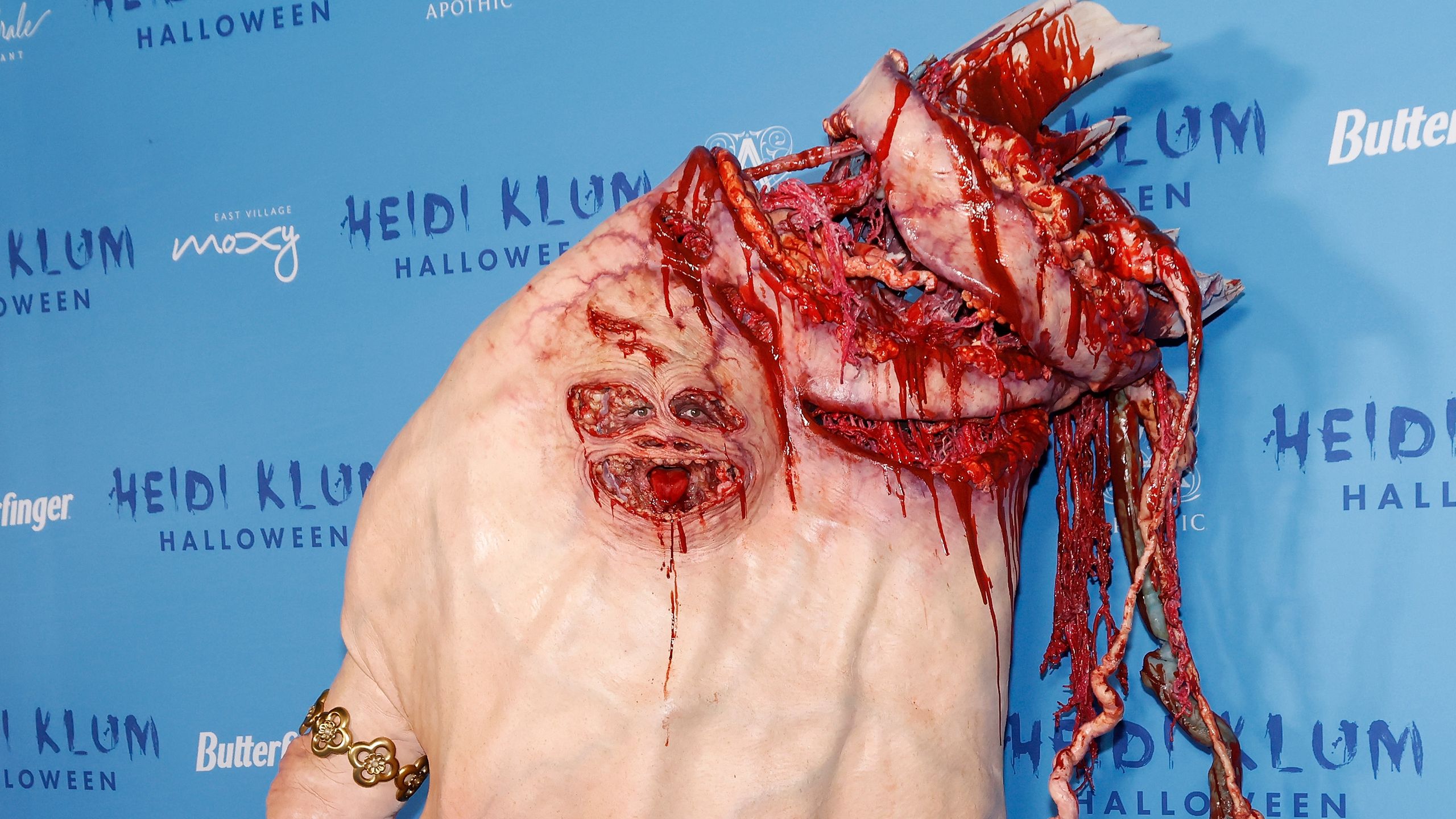
For Heidi Klum, the annual Halloween costume has become a cultural spectacle. On 2026’s Halloween night, she unveiled a creation that exceeded every prediction: a towering severed hand, rendered in graphic, lifelike detail. The hand was sculpted to match Klum’s own dimensions and featured her veins mapped across the surface, her engagement ring and wedding band visible on the fingers, and a vampy berry manicure. At the wrist, the severing revealed exposed bone fragments protruding through latex flesh and blood-red prosthetics. From the wound, Klum’s face emerged, layered beneath makeup and prosthetic work designed to simulate exposed muscle and tissue.
She had teased the reveal on Instagram, prompting followers to speculate wildly. Some guessed she might reference The Substance, the body-horror film that dominated conversation in recent years. When the hand finally appeared, it defied every prediction—no one anticipated she would transform herself into a detached limb.
A Quarter-Century of Reinvention
The Costume Legacy
This year marked the 25th anniversary of Klum’s Halloween celebrations, raising expectations considerably. Her costume history spans decades without a single repeat: Medusa with snakes writhing from her head, a grub with realistic segmentation, E.T. in drag with an elaborate wig, a feathered peacock. The consistency of never wearing the same design twice has become her defining trademark. Returning followers know never to predict what she’ll choose, and the anticipation itself forms part of the event.
The Creative Brief
“I wanted something unexpected, a little weird, a little creepy, and unlike anything I’d ever done before,” Klum wrote on Instagram. “Sometimes the most ordinary things can become the most extraordinary when you look at them a little differently.”
Planning began immediately after Halloween 2025 ended. Unlike spontaneous costumes, Klum’s annual reveals require months of conceptualization, fabrication, and refinement. Prosthetics designer Mike Marino, who collaborates with Klum on multiple costumes, led the creative direction this year.
The Prosthetics Engineer
According to Allure, Marino describes the costume-building process as “R&D experiments” with no predetermined roadmap. Each year brings new technical challenges and no instruction manual for solving them. For the severed hand, the requirements were clear: create a lightweight, wearable structure that could convey gore and humor simultaneously while allowing Klum to move naturally inside it.
Marino’s methodology began with sculptural work. He created two distinct layers for the face component. The first depicted internal anatomy—muscle, organs, and fat—rendered as accurately as prosthetic sculpture allows. The second layer featured a deliberately goofy expression that Marino felt would complement the giant hand and inject comedic absurdity into the overall effect.
“Like a mutant muppet,” Marino described the final look on Instagram, combining anatomical accuracy with theatrical exaggeration. This tonal balance proved essential: the costume needed to be unsettling enough to work as horror while remaining entertaining enough for a party setting.
Materials and Mechanical Engineering
Material Selection and Weight
The construction relied on specific material choices to balance durability with wearability. Marino selected lightweight upholstery foam and latex as the primary materials, a combination light enough for extended wear but substantial enough to hold detail and withstand an evening of use. Including harnesses, straps, and silicone reinforcements, the entire structure weighed between eight and 10 pounds—a remarkable achievement given the hand’s proportions.
The Motion System
The hand required more than passive structure. Klum needed to animate it to create the illusion of life and intentional movement rather than a static prop. Marino incorporated harnesses, mechanical elements, and motion-control systems that allowed Klum to manipulate the hand from inside. As Allure reported, these weren’t simple joints; Marino engineered mechanics that generated what he described as “organic” motion—movement that appeared natural and fluid rather than mechanical or jerky.
Klum pulled specific mechanisms to trigger movement and manipulate positioning throughout the evening. This added complexity required training and coordination; she had to operate the hand while maintaining her own balance and presence within the costume.
From Concept to Reality
The team completed as much fabrication and preparation as possible weeks in advance. Pre-work included sculptural development, fittings for proper weight distribution and movement, and pre-painting to establish color palette and texture before final assembly. This advance preparation allowed for problem-solving before the costume needed to function in real time.
On Halloween itself, actual preparation began around 3 p.m. eastern time. Despite months of advance work, final assembly and makeup application stretched into hours. Marino acknowledged a paradox that appears throughout his practice: “Miraculously, it always comes together, but somehow it always takes forever, even if it’s an easy thing.” What appears effortless to viewers represents the culmination of meticulous planning undermined by the inherent unpredictability of prosthetic assembly.
Klum emerged late in the evening, fully transformed and ready to make her entrance.
The Evening After
Klum did not maintain the full costume throughout the night. At some point she removed the enormous hand—a practical necessity given its size and the demands of a crowded party. The facial prosthetics and makeup remained intact longer, preserving the gory transformation even after the hand came off.
Given Klum’s established pattern, planning for 2027’s costume likely began moments after Halloween 2026 concluded. Next year’s reveal will face the same pressure to surprise, delight, and avoid repeating any design from her two-decade archive.
Source: Allure
Frequently Asked Questions
What materials was the hand made from?
Prosthetics designer Mike Marino used lightweight upholstery foam and latex, plus harnesses, straps, and silicone reinforcements. The entire structure weighed between 8 and 10 pounds.
How did Klum make the hand move?
Klum pulled specific mechanisms from inside the costume to animate the hand. Marino engineered the motion system to create organic, natural-looking movement rather than mechanical gestures.
Did Klum wear the full costume all night?
No. She removed the large hand at some point during the evening—a practical necessity given its size. However, she kept the facial prosthetics and makeup intact for longer.
