
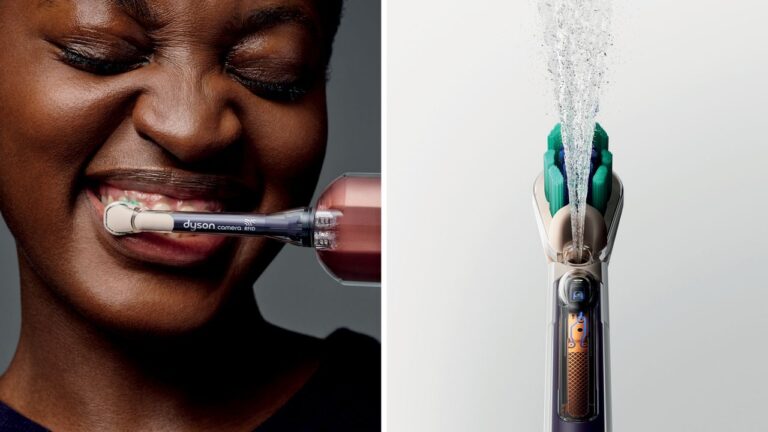
Key takeaways
- Dyson's $499 CameraJet combines brushing, water jet flossing, and real-time video recording in a single device engineered over nearly a decade.
- An embedded camera captures 28 images per second to guide a fan-spray water jet between teeth, using less than half an ounce of mouthwash while remaining comfortable.
- Clinical testing showed 17 percent of CameraJet users experienced reduced gum inflammation after four weeks versus 9 percent of manual toothbrush users.
- Allure editors found it lightweight, quiet, and usable even after makeup application, though long-term real-world effectiveness compared to cheaper alternatives remains unproven.
At $499, Dyson’s new CameraJet electric toothbrush represents one of the most technically ambitious entries into oral care since Sir James Dyson’s company first ventured into beauty. The product name was kept so secret that journalists visiting Dyson’s Cotswolds headquarters were forbidden from speaking about it, even to family members. Now fully unveiled, the CameraJet combines three distinct functions—brushing, water jet flossing, and real-time video capture—into a single handheld device designed to address the gap between what dentists recommend and what people actually do.
Closing the Oral Hygiene Gap
The average American and British person brushes for approximately 45 seconds, falling far short of the recommended 120 seconds. Flossing proves even more elusive: only about one-third of the population reports doing it daily. Dyson’s strategy with the CameraJet is to transform these mundane routines into something engaging and technologically compelling. Rather than simply speeding up the brushing experience, as the Supersonic hairdryer and Airwrap do for hair, the CameraJet asks users to slow down and pay attention to their oral care—with visual feedback and simultaneous cleaning.
Inside the Engineering Challenge
Building a Camera That Survives Motion
Embedding a camera inside a toothbrush head created unprecedented engineering obstacles. The brush head oscillates approximately 1,000 times per second, making any real-time visual recording extraordinarily difficult. “The camera is on a brush head that’s moving about a thousand movements a second. So the camera’s moving and you’re taking a film. Never mind the fact there’s a lot of water in the way,” Sir Dyson explained. Add foam, darkness inside the mouth, and the constant motion, and the task became what took engineers nearly a decade to solve.
Creating Synthetic Plaque for Testing
Dyson engineers needed a way to rapidly iterate on brush head designs without running clinical trials for each prototype. The existing proxy plaques on the market weren’t accurate enough representations of actual plaque, so Dyson partnered with Singapore University to develop their own. This five-year effort alone exemplified the company’s commitment to perfecting the technology before releasing it to consumers. Once in place, these artificial plaques allowed the team to complete hundreds of brush head iterations without waiting for human trials to generate results.
The Institute Driving Innovation
Many CameraJet engineers are graduates of the Dyson Institute of Engineering and Technology, which opened in 2017 on the Cotswolds campus and was authorized to award its own degrees in 2020. The program accepts 30 to 40 students annually, combining two days of classroom study with three days working on Dyson engineering teams, while earning a salary and paying no tuition. Niamh Turney, a CameraJet lead engineer, graduated from the institute and initially worked on the Airwrap before joining oral care. Sophie Harold, another graduate, credits her Dyson experience with teaching her the company’s standards for acoustic design and precision engineering.
How the Jet and Camera Actually Work
A Fan-Spray Approach
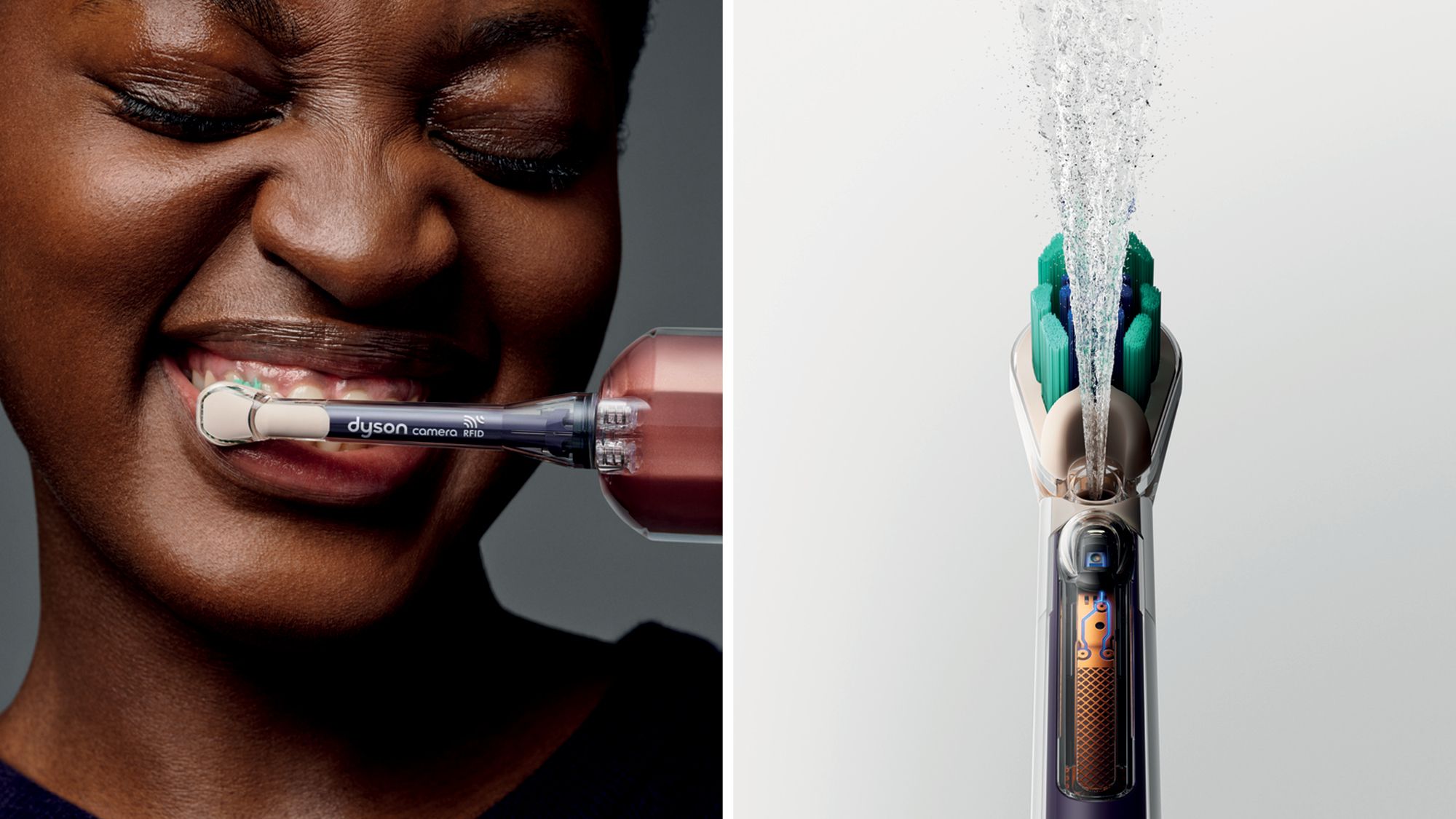
The CameraJet’s water jet operates fundamentally differently from traditional water flossers like the Waterpik, which Sir Dyson describes as unpleasant. Most water flossers emit a “needle jet”—a thin, piercing stream that blasts plaque through sheer pressure. Dyson’s alternative uses a fan-like spray pattern that covers more surface area while concentrating less pressure on any single spot. According to the company, this approach sweeps away plaque rather than punching through it, resulting in more effective bacterial removal without the aggressive sensation associated with conventional water flossers.
Camera-Guided Targeting
Mounted beneath the water jet and brush head is a camera no larger than a pencil tip, equipped with a 100mm pixel macro lens, an LED light, and processing capable of capturing 28 images per second. This continuous visual stream allows the camera to detect where each tooth begins and ends, automatically triggering the water jet to fire precisely in the gaps. Unlike competitors that require manual button presses or emit continuous streams, the CameraJet fires only when the camera identifies a target gap. This precision enables the toothbrush’s reservoir to hold less than half an ounce of mouthwash—compared to 7 ounces in the Waterpik Cordless Plus and 8 ounces in the Philips Sonicare Cordless Power Flosser 3000.
Multi-Use Video and Diagnostics
The embedded camera serves purposes beyond flossing guidance. Through the Dyson app, users can record and review videos of their teeth and gums in real time or save them for later viewing—potentially to share with dentists. These videos are not stored in the cloud or on app servers, addressing privacy concerns. Users can also activate the camera alone without starting the brush to inspect unusual sensations. Even Sir Dyson has experimented with alternative uses: “I’ve shoved it in my ear and it was very interesting. You get a very, very good image in your ear.”
Testing and Real-World Performance
First Impressions and Handling
Because Dyson enforces strict secrecy around in-development products, testing the CameraJet required extraordinary precautions. Allure editors Sarah Kinonen and one additional staff member conducted their trial in a bathroom suite at the Aman hotel on Fifth Avenue, with Dyson’s public relations team present. Both editors found the CameraJet enjoyable to use and described their teeth as feeling pristine after two minutes. The device weighs just over eight ounces—comparable to a roll of quarters—making it lighter than anticipated. The noise level proved significantly lower than existing electric toothbrushes and noticeably quieter than any water flosser either editor had encountered. The jet emits a slight “pfft” sound as it sprays into each gap, a sound that proved pleasant rather than jarring. One editor experienced minor drooling on the first use, described by observers as completely normal for newcomers. Importantly, the sensation felt dry enough that using the CameraJet after applying makeup seemed practical—something neither editor would attempt with conventional water flossers.
Reservoir and Orientation Flexibility
The docking station refills the toothbrush’s reservoir with mouthwash in three seconds at the press of a button. The pressure-controlled reservoir system eliminates air pockets and maintains fluid flow regardless of orientation—the fluid continued flossing when the toothbrush was held horizontally and even when inverted. One editor encountered an issue while cleaning inside lower teeth, as the jet stopped firing in darkness, which was quickly resolved by opening her mouth slightly to allow more light to reach the camera’s lens. Neither editor depleted the mouthwash supply during a testing session that extended past the standard two-minute brushing time.
Competitive Positioning
The Soocas NEOS II Ultra Electric Toothbrush, another hybrid device, holds 1.7 ounces and flosses for 80 seconds after brushing. When held horizontally, however, it cannot draw from a low reservoir, causing users to run out mid-session—a limitation the CameraJet’s pressure-controlled system overcomes entirely.
Clinical Support and Limitations
Dyson conducted internal and external laboratory testing on the CameraJet, claiming superior performance versus market-leading competitors at removing plaque. The company provided Allure with results from a four-week clinical trial involving 60 subjects, comparing a manual toothbrush against the CameraJet. The CameraJet showed improvement across every measured metric. After four weeks, 17 percent of CameraJet users demonstrated reduced gum inflammation compared to 9 percent of manual toothbrush users. However, Allure notes that comparing a high-tech electric brush to a manual toothbrush resembles contrasting a mortar and pestle with a VitaMix—a significant methodological gap. Based on approximately 300 combined seconds of testing time across the Allure staff, the editors cannot definitively confirm that the CameraJet outperforms less expensive electric toothbrush-and-string-floss combinations in real-world, long-term use.
Frequently Asked Questions
What makes the CameraJet different from traditional water flossers like Waterpik?
The CameraJet uses a fan-like spray instead of a needle jet, reducing pressure on gums while covering more surface area. An embedded camera guides the water jet to fire only between teeth, requiring less than half an ounce of mouthwash compared to 7-8 ounces in traditional water flossers.
Is it safe to use the CameraJet after applying makeup?
Yes. The CameraJet delivers a dry experience unlike conventional water flossers, making it practical to use after makeup application without causing dripping or overflow.
How long did the CameraJet take to develop?
The concept arose nine years ago, with engineers spending six years on development. Creating synthetic plaque for testing alone required five years in partnership with Singapore University.
