
Key takeaways
- Allure launched the Best of Beauty Awards in October 1996 with 234 winners, filling a critical gap for consumers navigating an overwhelming array of products.
- The awards' success came from rigorous testing by editors, makeup artists, dermatologists, and contributors, combined with editorial independence.
- By keeping winners confidential until publication, Allure created genuine surprise that made indie brands successful overnight.
- What started as a controversial editorial decision transformed the beauty industry by proving readers value honest curation over brand advertising.
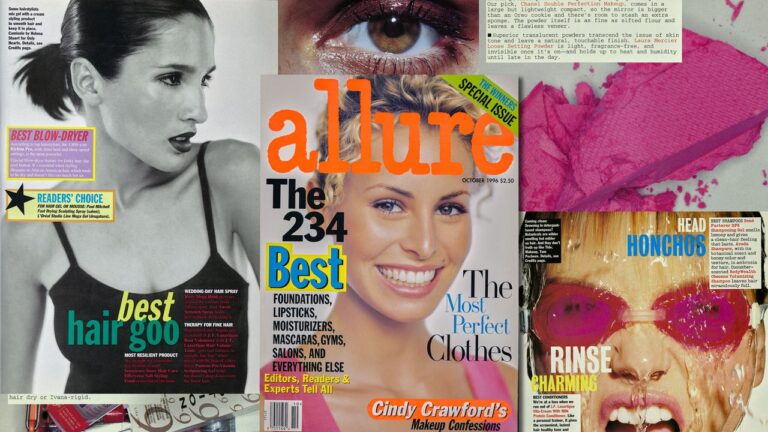
In October 1996, Allure magazine published the first Best of Beauty Awards. The inaugural list featured 234 carefully selected winners, from established names like Estée Lauder to Chanel’s newly launched Vamp nail polish. Readers immediately bought out winning products. Brands faced unexpected stock-outs. In the pre-internet age, when social media didn’t exist and dial-up connections moved slowly, Allure had created something that would become the beauty industry’s most influential seal of approval.
The Radical Idea and Industry Controversy
The concept violated an unspoken rule: women’s magazines never declare one product better than another. Declaring a winner means implying all others are losers—risky when advertisers fund the publication. But Linda Wells, Allure’s founding editor in chief, had experienced the problem firsthand. “I remember going into a drugstore and thinking, This is impossible! I don’t even know where to start,” she recalls. She had drawn inspiration from wine critic Robert Parker, who gave consumers confidence through numerical ratings—a way to navigate overwhelming choice without expertise.
S.I. Newhouse, Condé Nast’s then chairman and CEO, saw only career risk. “You can’t do this, you’re committing career suicide,” he told Wells. His concern was legitimate: what gave a magazine the authority to be so definitive? Allure was not Consumer Reports, with laboratories and scientists. It was naming favorites based on editorial opinion—informed, yes, but ultimately subjective. Yet Newhouse had learned to trust Wells. In 1991, when Allure launched and committed to editorial honesty, telling readers when products didn’t work as claimed, nearly every major advertiser pulled out except Estée Lauder. Through that backlash, Newhouse supported her completely.
Distinguishing Best of Beauty From Previous Approaches
Wells understood what would make Best of Beauty different. Years earlier, Allure had run “Road Test,” where editors tried products and declared them successes or failures. When brands learned editors had “played a game” with years of development, only to call the result a flop, relationships fractured. Best of Beauty avoided that trap. It celebrated products only—no declarations of failure. In her editor’s letter for the first issue, Wells wrote: “This is our opinion. These are the things we like right now and why we like them right now. These are not the best products of all time, forever and ever, case closed.”
Inside the Testing Operation
By May 1996, when editorial assistant Kristin Perrotta started, the Allure office resembled “a Sephora that had exploded.” This was before Sephora had even launched in the United States. Products filled the beauty closet, hallways, art department, and production zones, stacked so precariously that staff feared collapse. The workload was immense. Perrotta worked seven days a week and still needed help. She enlisted her then-boyfriend Jeff and friends to come on weekends and evenings. “We’d have pizza parties and they’d help me bag stuff up for people,” she recalls. Allure’s managing editor distributed car service vouchers like candy—no one was hauling those heavy bags on the subway.
Consulting Beauty Professionals
Testing extended far beyond the magazine’s staff. Allure brought in makeup artist Kevyn Aucoin, hairstylists, dermatologists, and cosmetic chemists. The magazine tapped contributors, freelancers, and what Perrotta calls “fancy socialites” to take products home and evaluate them. Aucoin required some coaxing. Wells remembers “enticing him with pizza and Coca Cola to test products. It was like having a teenager. My assistant would order the food to arrive right before he walked in.”
Staff writer Jennifer Tung recalls the precision required. “I had to be like, ‘Does it feel like yogurt?’ or ‘What’s the consistency of this cream?’” Working from pen-and-paper ballots, she filled stacks of pages with product descriptions. “At one point I ran out of adjectives,” she admits. “Those days were incredible because you got to be really clever and have a lot of fun. The more you pushed it, the better.”
The Rigorous Testing Process
The rigor was genuine. Editors maintained testing charts and compared products against each other. They met to argue cases, consulted with professionals, and selected finalists only after scrutiny. “Everybody had these charts, and compared one thing to the other. And then we’d meet, and talk, and argue,” Wells explains. “We’d consult with makeup artists, hairstylists, dermatologists, and cosmetic chemists. Then we’d pick our finalists.” For the first year, this took about three months—shorter than today’s nine-month cycle testing 5,568 products to select 319 winners, but possible only because fewer products existed and Allure’s expertise was unmatched.
Why the Awards Succeeded
With roughly 3 million in circulation, success was immediate. Readers bought out winning products. Brands, completely unprepared, faced stock-outs and pleaded with Wells for advance warning so they could manufacture enough supply. She refused. Keeping winners confidential until publication was essential to editorial independence—and that refusal became central to the awards’ mystique.
Indie brands found themselves unexpectedly successful. “We’d hear that over and over again from these indie brands: ‘You made our business. We didn’t think we were going to survive had it not been for a Best of Beauty award,’” Wells says. The awards didn’t favor giants; they rewarded genuinely excellent products regardless of advertising budget or brand size.
Carol Hamilton, vice president of marketing at L’Oréal Paris at the time, recognized what was shifting. “I think Best of Beauty was very powerful because it was one of the first curations of beauty products in a way that the consumer could relate to,” she says. “It was from an editorial perspective rather than a brand perspective… all of a sudden, there was something that helped the consumer understand that editors had chosen them. That knowledge was not available to people before then.”
From Whisper to Institution
Because of early hesitation in the industry, Allure didn’t celebrate the first award with fanfare. “We tiptoed into Best of Beauty, and deliberately didn’t have a party to celebrate it,” Wells explains. “It became something that people anticipated. It became a seal. It became advertising, licensing. It became a Today show segment, but none of that happened at the beginning.”
Five years later, in 2001, Allure hosted the first official celebration at the Four Seasons Restaurant in New York with brand executives. Publisher Nancy Berger and Wells deliberately avoided a traditional awards format—announcing winners implied losers, which felt wrong to them. For the 10th anniversary in 2006, they escalated the celebration to a party at the Rainbow Room in New York.
Today, the awards have only grown in influence and scale. Allure tests roughly 5,568 products annually over nine months to crown 319 winners, nearly a hundred more than the inaugural list. What started as a risky editorial stance proved that readers value honest curation over brand loyalty. Best of Beauty demonstrated that editorial independence, even when controversial, ultimately builds trust that no amount of advertising can replicate.
Frequently Asked Questions
When did Allure's Best of Beauty Awards first launch?
The first Best of Beauty Awards published in October 1996, featuring 234 product winners selected by Allure's editors, makeup artists, dermatologists, and contributors.
How does Allure select products for the Best of Beauty Awards?
Editors test products using detailed comparison charts and meet to argue cases, consulting with makeup artists, hairstylists, dermatologists, and cosmetic chemists before selecting finalists for rigorous scrutiny.
Why does Allure keep Best of Beauty winners confidential?
Keeping winners secret until publication maintains editorial independence and prevents brands from preparing in advance, creating the genuine surprise that drives consumer attention to winning products.
