
Key takeaways
- Natural hair creators are shifting from niche brands to mainstream salon products like Olaplex, Amika, and K18 for better results.
- Hair density, not just curl pattern, has become the primary factor in choosing products that work.
- Bond repair technology and silicone-based products, once avoided, now deliver tangible benefits for textured hair.
- Black-owned brands continue innovating, while the broader industry finally invests in formulas for Black hair.
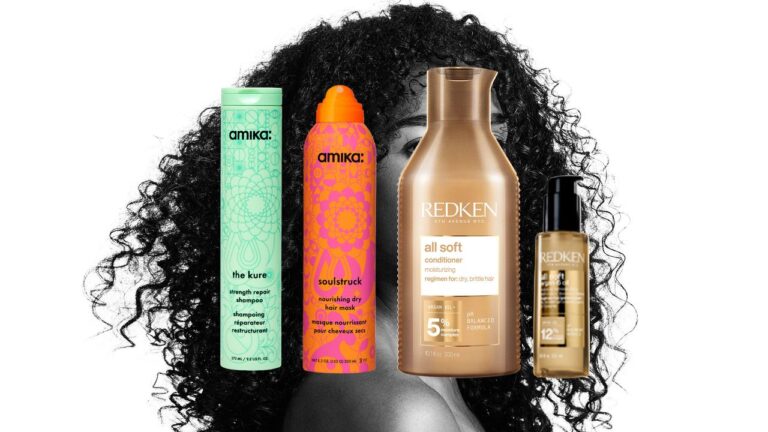
Natural hair creators have undergone a quiet shift in recent months. Where Black beauty feeds once celebrated indie, niche-focused brands designed specifically for textured hair, conversations are now dominated by salon staples—Redken, Amika, K18, Olaplex—occupying space alongside drugstore classics.
Creator Deborah Wanjala documented her years-in-the-making product arsenal in a recent video, featuring the Abbey Yung hair method alongside products from Amika, Living Proof, K18, and Redken mixed with Dove and Pantene. Over on Reddit’s r/Naturalhair, a post celebrating Redken and Ouai products garnered more than 600 upvotes, with commenters overwhelmingly agreeing about the effectiveness. Another influencer, @not3shaunie, endorses Yung’s damage-reversal guides, explaining how heavier creams and custards weigh down her fine, low-density hair, while lighter serums from brands like Redken deliver visible results without the flatness.
The testimony repeats across platforms. Type “Black hair” or “curly hair” into TikTok, Reddit, or YouTube alongside any major salon brand, and countless creators describe transformation. Straight naturals and curl enthusiasts alike are building hybrid product routines, rotating brands depending on styling intention for the week. Natalie Tuffuoh, a fashion professional and straight natural, pairs Cécred and Silicon Mix for nourishing treatments, then reaches for Amika, Kenra, or IGK for salon-quality blowouts that hold between washdays—finishing with ColorWow’s Extra-Strength Dreamcoat to extend the style.
Even those wearing tighter textures have joined the trend. Amsterdam-based creator @5sabrine posted a viral series on treating her fine, curly hair as “hair”—not specifically curly hair—and watched her growth accelerate. Her ongoing “fine, curly hair routine” content has accumulated over a million views, reflecting a broader recognition that hair density matters as much as texture when selecting products.
The Discovery of Product Specificity Beyond Texture
For decades, natural hair influencers organized recommendations around curl pattern: coily, curly, wavy, and straight. That taxonomy has cracked under the weight of a simpler truth: a woman with fine, curly strands and one with thick, curly strands need completely different formulas.
Hair Density as a Primary Factor
Creator @yapahcurls labels herself explicitly as “your fine hair bestie,” rejecting the notion that all natural-haired women can follow the same advice. Whitney White, perhaps the largest voice in natural hair history, built her following on routines suited to thicker, denser hair—advice that doesn’t translate across hair densities. Yapah Curls’s recommendation videos pull from Black-focused brands like The Doux alongside mainstream lines from Eva NYC, Garnier, and L’Oréal Paris, selecting by need rather than brand origin.
Rotation and Flexibility
Yar Sudani, who commands 2.4 million followers across TikTok, Instagram, and YouTube, treats product selection as situational. Her Wash Day Diary series sometimes features nearly all salon brands—Olaplex, K18, Bumble and Bumble, Innersense—and other times leans entirely into Black-owned lines like Pattern Beauty, Mizani, and Carol’s Daughter. The point, implicitly, is that rigid brand loyalty no longer governs decisions; results do.
Straight Styles and Heat Work
The shift toward salon brands makes intuitive sense for heat-styling outcomes like silk presses and blowouts, where formulas designed for that application deliver results difficult to replicate with niche brands. But the surprise is their presence in air-dried routines on fine coils and waves—textures that benefit from the lighter formulas these brands now offer.
The Business and Marketing Reality
The natural hair movement of the past two decades positioned indie, Black-owned brands as the ethical and effective choice. That narrative rested on substance: formulas heavy in natural oils, butters, and free of sulfates and silicones, formulated in direct opposition to the heavy relaxers and stripping products of the previous century.
Cosmetic scientist Javon Ford explains the positioning: Black-tailored brands adopted a natural approach, contrasting themselves against earlier 20th-century products like Lustre Pink and Soft Sheen, which fought to straighten coily hair. This shift reflected justified historical mistrust. Cosmetic scientist AJ Addae notes that the focus on clean, botanical ingredients emerged from a legacy of medical and cosmetic exploitation—including dermatological experiments on Holmesburg Prison inmates (predominantly Black men) that led to Retin-A’s invention, and the ongoing disproportionate toll of lye relaxer complications on Black women’s health.
Yet the clean beauty movement hit limits. Larger beauty conglomerates acquired successful Black-owned indie brands. Mainstream companies with vastly larger research budgets began developing curl-specific lines for the first time, targeting a market they’d historically ignored.
Technological Innovation and Bond Repair
The most visible example of salon-brand innovation reaching natural hair creators is bond repair technology. Olaplex introduced consumer versions of its in-salon treatment in 2018; by 2024, the brand had released a Bond Shaping Technology line specifically engineered for curly hair types. K18 launched in 2020 with proprietary bond-repair technology, positioning itself as a competitor without marketing exclusively to any single hair type—its 2024 AirWash Dry Shampoo campaign featured a model wearing braids. Amika entered the space with its Power Hour Curl Refreshing Hair Spray in 2021, expanding its curl-specific offerings to three products, and launched Hydro Rush in 2023 to deliver hydration without weight.
Hairstylist and Olaplex ambassador Naeemah LaFond explains the science. Curly and coily hair has a more complex structure; the bends and coils distribute stress unevenly along the strand, making breakage and moisture loss more likely without proper intervention. When the disulfide bonds holding fibers together rupture through chemical services or heat, resilience drops visibly. Addae validates this chemistry: “These are the exact chemical interactions we have to consider when formulating for textured hair.”
Only three bond repair ranges come from brands prioritizing curly and coily hair—Shea Moisture, Curlsmith’s Bond Rehab, and As I Am’s six-product Bond Repair lineup, which remains affordable and overlooked in mainstream technology roundups.
The Sulfate and Silicone Reversal
Ingredients once reviled in natural hair spaces are staging a comeback. Sulfates and silicones, according to cosmetic chemist Julian Sass, need not be villainous; sulfates clean effectively while remaining gentle and hydrating in proper formulations. Silicones, when dosed correctly, provide slip, reduce friction during detangling, and significantly ease the stress on tightly coiled strands—a tangible health benefit, not just cosmetic convenience.
Black women report stronger strands with more spring and lightness when they replace natural oils and greases with silicone-based serums and gloss treatments. Addae reinforces the nuance: “Silicones get a bad reputation for buildup, but at the right concentrations they provide slip, reduce friction, and make detangling significantly easier, which is a health benefit for tightly coiled textures.” The takeaway isn’t that natural ingredients were wrong, but that blanket ingredient rules serve no one—understanding hair’s actual needs trumps ingredient ideology.
The Post-Natural Hair Landscape
The contemporary Black hair landscape contains more variation than ever. Straight-haired naturals coexist with wash-and-go creators, heat-trained hair enthusiasts, and those returning to lye-free relaxers or smoothing treatments. Each group has discovered holy grails, and those discoveries increasingly converge on professional-grade formulas available at home.
Black women have invested decades in becoming hair scholars, researching independently when the beauty industry neglected their texture. That expertise, paired with expanded options, has created a moment where the community can cherry-pick across brands by actual performance rather than brand philosophy.
Ford notes that innovation hasn’t abandoned Black brands entirely. Carol’s Daughter released a minoxidil hair serum—the first Black brand he knows of to enter that category while others maintain natural oil-focused growth products. Jay-Ann Lopez, a gaming industry member experimenting with her hair publicly, sees this as opportunity rather than defeat. “Black brands haven’t been at the forefront of certain technologies might be a good thing,” she explains. “Now they can study other brands to strengthen their position, then bring cultural and social capital to the sector—something Cécred is already doing so well.”
Recent appointments of prominent Black and mixed-race hair professionals to senior positions at larger brands signal movement on visibility and investment. The industry is listening, particularly when Black women lead the conversation at the helm.
Frequently Asked Questions
Why are natural hair influencers switching to salon brands?
Creators discovered that products designed for specific hair densities and textures provide better results than one-size-fits-all formulas, and newer salon-brand technology like bond repair delivers salon-quality outcomes at home.
What is bond repair technology and why does it matter for natural hair?
Bond repair restores disulfide bonds disrupted by heat or chemical services; it's especially beneficial for curly and coily hair, which has uneven stress distribution along strands and higher breakage risk.
Are sulfates and silicones safe to use on natural hair?
Yes—when formulated properly, sulfates can be gentle and hydrating, while silicones at the right concentrations provide slip and reduce detangling friction, both of which are health benefits for tightly coiled textures.
