
Key takeaways
- Blepharoplasty is the top surgical option but carries risks of looking unfamiliar or overly surgical—some candidates benefit more from endoscopic brow lifts, which work from above and often appear less obviously operated-on.
- Nonsurgical eyelid lifting requires a layered protocol: EmFace strengthens muscle support, Sofwave rebuilds collagen, and SmoothEye refines the eyelid skin itself, with results emerging over months rather than weeks.
- A millimeter of surgical fat repositioning delivers more dramatic structural change than years of nonsurgical devices, but the gradual improvement from layered treatments avoids the risk of looking unrecognizable to people who know you.
Across a crowded restaurant, my neighbor caught my eye and waved. Recognition took a moment—something about her face had changed. Her eyelids sat higher, her eyes appeared wider, her expression radiated alertness. A distinctive pendant at her collarbone finally confirmed her identity. She’d undergone blepharoplasty. The surgery had achieved its technical goal: lifted lids, more open eyes, refreshed appearance. Yet something felt unsettling. The transformation was so complete that she’d become someone I barely recognized. That evening, I called to cancel my own surgical consultation.
For months, I’d been building toward that appointment. The typical triggers started the process: video call lighting that exposed every shadow, afternoon light that seemed to deepen the lines around my eyes. But the real issue wasn’t wrinkles. My upper eyelids felt genuinely heavier, and the space between my lash line and my crease seemed to disappear beneath a drooping overhang. By mid-afternoon, I’d catch myself fighting to keep my eyes open. I’d always had mild eyelid hooding—visible in childhood photos—but something had shifted in my early 40s. My father, now 80, has watched his own eyelids gradually descend, sometimes partially obstructing his vision on particularly saggy days. I recognized the beginning of that progression in my own face.
Every dermatologist I consulted mentioned blepharoplasty casually, the way someone suggests fixing a cracked phone screen. They weren’t judgmental—just matter-of-fact. Blepharoplasty ranks consistently among the top five cosmetic surgical procedures in the United States, according to the American Society of Plastic Surgeons. TikTok’s #blepharoplasty hashtag has accumulated more than 542 million views, where before-and-afters and surgeon reaction videos form their own thriving ecosystem. Yet seeing my neighbor’s result gave me pause. If surgery could make someone unrecognizable, what was I actually pursuing?
The Architecture of Aging Eyes
What Happens to the Bone and Tissue
Understanding why my eyelids felt so much heavier required learning what actually changes with time. “The shape of the eye socket remodels, and the bone breaks down,” explains Joshua Zeichner, MD, a board-certified dermatologist in New York City. “Plus, soft tissue volume shifts, so the eyes physically sit deeper within the skull.” This isn’t superficial—it’s structural. The bone that frames and supports the eye reshapes itself, repositioning how everything sits in your face.
Simultaneously, the orbital septum—the internal scaffolding holding everything in place—gradually loses elasticity. Robert Schwarcz, MD, a board-certified oculoplastic surgeon specializing in blepharoplasties, describes the cascade: “The fat can protrude forward as the orbital septum becomes thinner and less supple. Additionally, the orbicularis oculi muscle loosens and descends downward.” The result feels like a cascade of loosening: support systems weaken, tissues shift downward, everything droops slightly. Zeichner uses a visual metaphor that stuck with me: “You’re wearing a pair of Spanx that has loosened over time, and the fat is bulging out.”
The Misconception About Puffiness
Most people assume undereye bags mean they’ve gained weight. Adam Kolker, MD, a board-certified plastic surgeon in New York City, offers a counterintuitive explanation: “People misconstrue that extra fullness of the lower eyelid as gaining fat. It’s actually the opposite. The septum becomes lax, and you lose some of the superficial soft tissue volume. When the tide goes out, you see more of the fat pocket and more of the shadow.” The fullness isn’t new fat—it’s existing fat that’s become more visible because the supporting tissue around it has weakened.
How Lids Change Expression
The upper face carries tremendous communicative weight. Eyes, brows, and forehead transmit the emotional cues that shape how others perceive us. Shift an eyelid by even a millimeter, and your entire expression recalibrates. As anatomy shifts with age, the story your eyes tell changes without your intention. You can feel completely alert and engaged, but your face reads as exhausted, disinterested, or unwell. That disconnect between internal state and external appearance is often what drives people to seek solutions.
Why Blepharoplasty Wasn’t My Answer
Before pursuing any treatment, I needed to understand whether my specific anatomy would be a good fit for surgery. I sent photos to Jason Diamond, MD, a board-certified facial plastic surgeon in Beverly Hills. His response gave me serious pause.
First, he suggested I might have both ptosis and negative-vector anatomy—a combination that changes surgical strategy significantly. Negative-vector anatomy means the eyes protrude slightly forward relative to the cheekbones. It sounds concerning but is actually a positioning issue within the skull. “Negative vector patients with ptosis are tough,” Diamond explained. “You have to be very careful about how much skin you remove in a blepharoplasty because you can create a real hollow look, like an owl’s eye. The excess skin actually looks better than the alternative.” In other words, surgery could correct the hooding but might leave me with a permanently hollowed-out appearance. That trade felt worse than the original problem.
Diamond offered a second suggestion that surprised me: “More than 50% of the time, an endoscopic brow lift is actually more undetectable than doing the upper eyelids.” This procedure works from above, through small hairline incisions, releasing the ligaments anchoring the brow. “Think of it like a strip of Velcro running all the way across the brow,” he said. “Once it’s released, you can slide everything back up.” The difference matters: a brow lift restores support rather than removing tissue. Often it looks less obviously surgical. But even this option meant surgery, with recovery time and permanent changes. My neighbor’s unsettling result still lingered in my mind. I decided to test what nonsurgical tools could realistically deliver first.
Building the Treatment Protocol
I consulted with Ava Shamban, MD, a board-certified dermatologist in Los Angeles, who aligned with Diamond’s thinking. “For you, we don’t want to erase the hooding. We want to tighten and support it,” she said. Her strategy involved a carefully sequenced series of nonsurgical treatments—some in-office, some at home—targeting multiple factors: muscle tone, collagen integrity, surface texture, and ligament support. Over eight months, we worked through treatments in phases, each one assessed before moving to the next. The goal was gradual improvement rather than chasing one dramatic transformation.
Phase One: Strengthening Muscle Support
EmFace combines radiofrequency energy with high-intensity electromagnetic stimulation to strengthen muscles. During each 30-minute session, a grounding pad went on my stomach while adhesive strips positioned across my forehead and under my eyes delivered pulses. My brows and undereye areas contracted involuntarily in rhythmic waves—not painful, but an odd sensation of muscular work happening without my consent. “The brow elevators are muscles,” Dr. Shamban explained. “If we strengthen the lifters without over-relaxing the depressors, we create upward support.” The strategy targets the mechanics of support: strengthen what pulls upward instead of just freezing what pulls down, which is what Botox accomplishes.
I completed four treatments spaced one week apart at a cost of $1,800 for the series. By week four, I noticed subtle but real changes: my brows felt more supported, with a slight visible lift at the outer corners that made my eyes appear more open. Full results emerged over three to four months. The effect lasts approximately six months.
Phase Two: Rebuilding Collagen
Four weeks after starting EmFace, Dr. Shamban layered in Sofwave. While EmFace strengthened muscle, Sofwave targets skin itself through focused ultrasound energy penetrating the mid-dermis—deep enough to stimulate collagen and elastin production but shallow enough to preserve volume in the delicate undereye area. The goal is making existing skin thicker, denser, and more supportive without removing anything. “If you tighten along the brow, you can get a visible lift,” Dr. Shamban noted.
During treatment, concentrated heat built to sharp peaks—like pressing a hot spoon against the brow for a single second, repeatedly. Forty-five minutes of numbing cream beforehand made it tolerable. For the most intense passes over the brow bone, where skin is thinnest, I requested Pronox (nitrous oxide) to manage the sharp sensation. The single treatment cost $1,250. A visible tightening along the brow and upper lid emerged within twelve weeks. This effect persists for one to two years. (Dr. Shamban also mentioned that some practitioners prefer Thermage FLX or Ultherapy PRIME for similar collagen-stimulating effects around the eyes.)
Phase Three: Treating the Eyelid Directly
Even with strengthened brows and tightened skin above, the eyelid itself could still appear lax. The Fotona Dynamic Pro SmoothEye uses a non-ablative Er:YAG laser targeting the tissue-thin eyelid skin specifically, triggering collagen remodeling. Unlike broader brow treatments, this zeroes in on the eyelid. “We’re contracting existing collagen while stimulating new production,” Dr. Shamban explained. “The goal isn’t to change your anatomy. It’s to make the tissue behave younger.”
Treatment felt like warm pulses building gradually, similar to a heated massage around the eyes. I underwent three treatments spaced four to six weeks apart. The outcome was visible firming, especially along the fold where hooding collects, with less creepiness visible. Results emerge gradually over three months and hold for approximately one year. Individual costs run $600 to $1,200 per treatment depending on the area treated. This procedure still has limited clinical data, so results should be viewed as refinement rather than reinvention.
The Cumulative Picture
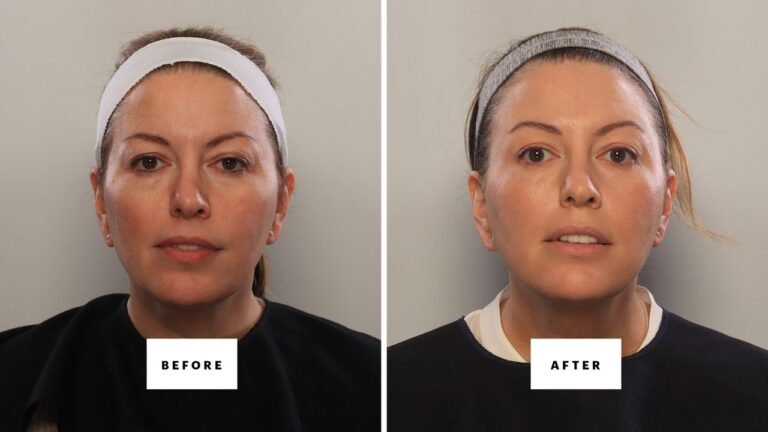
Eight months into the protocol, the effects of layered treatments compounded. My eyelids felt measurably lighter—not surgically transformed, but noticeably improved. The structural support that EmFace created gave the skin something to work with when Sofwave tightened it. The eyelid-specific laser work then refined that foundation. I could open my eyes more readily in the afternoon without that afternoon-fatigue sensation creeping in. My face read as more alert without appearing operated-on or unfamiliar to the people who know me well.
Was it a blepharoplasty substitute? Not exactly. A millimeter of surgical fat removal or repositioning, completed in an hour, delivers more dramatic structural change than years of nonsurgical devices. My neighbor’s result hadn’t failed—surgery had worked as intended. But seeing her unrecognizable face made me realize I wanted something different: improvement without reinvention. The protocol I completed delivered exactly that—a face that still looked like mine, just more rested and more open. For someone uncertain about surgery or concerned about outcomes changing their appearance too dramatically, nonsurgical layering offers a legitimate middle ground.
Frequently Asked Questions
Can nonsurgical treatments like EmFace and Sofwave replace blepharoplasty?
Nonsurgical treatments can strengthen muscles and tighten skin, creating a noticeable lifted appearance over eight months. However, a millimeter of surgical fat removal or repositioning—accomplished in an hour—delivers more dramatic structural change than years of devices. Nonsurgical approaches work best for those seeking gradual improvement without surgical recovery or the risk of looking unrecognizable.
What does EmFace actually do, and how long do the results last?
EmFace uses radiofrequency and high-intensity electromagnetic stimulation to strengthen brow muscles that naturally lift the eye area. A series of four treatments costs $1,800 total, with full results emerging over three to four months. The effect lasts approximately six months, after which retreatment is needed to maintain results.
Is it safe to use multiple eyelid treatments in sequence, and how are they spaced?
Yes, treatments can be layered strategically. EmFace starts first to build muscle support; Sofwave is added about four weeks later once the brow muscles have strengthened; and SmoothEye (three sessions spaced four to six weeks apart) refines the eyelid skin. This phased approach allows your face to respond at each stage and allows the dermatologist to assess results before adding the next treatment.
