
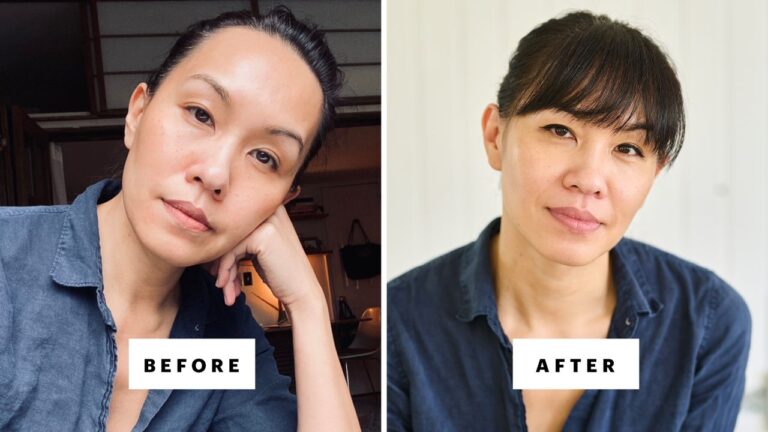
Key takeaways
- She quit Botox, fillers, GLP-1 medications, and laser treatments, and her body naturally settled at the same weight she met her husband at twenty years prior.
- Grief dominated her first year off treatments, moving through five distinct stages before she found value in her mind and writing rather than her appearance.
- Her new routine uses prescription retinoid, serums, creams, and minimal makeup—tools for nourishment rather than correction, along with oral minoxidil and spironolactone for hair loss.
- Happiness and genuine beauty emerged when she shifted focus from fixing her face to building intellectual friendships and creative pursuits.
After more than a year of questioning what she really wanted, a woman in her 40s made a radical decision: she stopped all cosmetic procedures, medications, and aggressive treatments. No more Botox, fillers, lasers, or GLP-1s. What followed wasn’t smooth or easy. Instead, it unfolded like grief—five distinct stages of it—before leading to an unexpected and quieter form of self-acceptance.
The decision point came during an appointment at an Upper East Side medical office, where the sterile white walls and gray cabinetry gave the space an almost clinical coldness. Sitting in a designer chair, surrounded by faces with the characteristic frozen expression of Botox treatments, she found herself struck by her dermatologist: a pregnant Asian woman also in her 40s, skin so clear it appeared digitally rendered. This woman represented the pinnacle of what the cosmetic industry promised—youthful perfection—yet looking at her, the patient realized she no longer wanted to look that way. She no longer wanted to look like a frozen clock. When the office emailed to confirm her next filler appointment, she delayed it by a week. That week became two, then three, then six months, then indefinitely.
The Years Before: A Catalog of Procedures
Before this pivot, the medical interventions had accumulated steadily across decades. In her teenage years, she had bought Covergirl cosmetics religiously, wearing eyeshadows meant to make her eyes appear bigger and rounder, foundations to lighten her skin, concealers to thin her nose. In her 20s, heavy makeup became her uniform, along with push-up bras and five-inch heels. She had seriously considered getting a breast augmentation.
By her 30s, the procedures intensified. She became consumed with mini-facials, lash lifts, and brow laminations. When a microblading session went too far—the artist working her brows aggressively—she spent the next two years attempting removal with painful lasers and chemical acids. Her monthly Amex bills climbed into the thousands of dollars.
In her 40s, injectable treatments entered the picture: Botox, dermal fillers, and compounded semaglutide (off-brand Ozempic). She had even considered a facelift. Yet despite the accumulating procedures and the escalating financial investment, she felt strangely underwhelmed when looking at herself. She had engineered a slightly better version of her anxiety, nothing more.
The First Stage: Disorientation and Denial
Stopping the treatments meant stopping the regularity of those appointments, the ritual of maintenance, the external scaffolding she had built around her face and body. The aftermath was jarring. She didn’t recognize herself—or more accurately, she didn’t like what she saw. The real face, unsmoothed and unfilled, looked like a stranger’s.
Displacement and Avoidance
She avoided mirrors at all costs. Instead of facing that reflection, she filled her hours with displacement activities. She picked up books she had been meaning to read for years. She rejoined the gym and began running toward a 5K twice a week, pushing herself determinedly. Almost on impulse, she applied to an MFA program in creative writing. She told herself she was simply staying busy, but what she was actually doing was building something new.
The Body’s Weight Settles
Stopping the GLP-1 medications—the compounded semaglutide she had injected for three months trying to reach a specific number on the scale—meant allowing her body to settle. The scale eventually read nearly the same weight it had been twenty years earlier, when she first met her husband. It was the same number she had white-knuckled her way toward through pharmaceutical intervention. Now it had arrived without effort or deprivation.
The Emotional Reckoning: Five Stages
As the weeks stretched into months without treatments, she moved through distinct emotional phases.
Anger and Wasted Time
Anger came early. She raged at the years she had spent in that cycle of self-obsession, at the money wasted trying to outrun a biological process happening regardless of her resistance. Then came the cruel timing: perimenopause arrived exactly as she was making peace with herself, bringing hair thinning and skin shifting and every negotiated term of her body’s agreement renegotiated without consent.
Despair and Temptation
Despair followed. Late in the evenings, she stalked her dermatologist’s website, scouring promotions. Half a vial of Botox for her “elevens” (the vertical lines between the brows). One syringe of filler for her smile lines. No one would notice but her, she told herself. She had entire conversations about this with herself in her bed, in her car, at work—arguments for why she should return.
A New Kind of Grief
Then came a stage without a common name, one that no one warns you about: a low, loathsome feeling that settles like damp weather. She felt ugly in a way she hadn’t since age 13, helpless like a girl without agency or money to fix what she thought was broken. She mourned her youth the way you mourn something you never appreciated until it was gone. She felt envious of younger women, sad in their presence in a way she couldn’t articulate.
The Shift: Being Seen Beyond Beauty
What eventually pulled her through was incremental and almost mundane: a book finished, a page written, a conversation with a friend or colleague that mattered. She went back to school in her 40s and sat in classrooms with people who cared about sentences and ideas, about finding the precise word for an imprecise feeling. She started writing more seriously than she ever had, which meant paying closer attention to the world and to herself.
After a year of grieving, something crystallized. She was in a workshop when someone responded seriously and thoughtfully to a piece she had written—something personal and exposed. She felt seen, but not as a pretty face. She was seen as a mind, as a voice. Driving home that evening, she caught herself in the rearview mirror and didn’t look away. She stared at the face of a woman in her mid-40s who had been through things, and instead of criticism, she thought simply: There you are.
The New Regimen: Pleasure, Not Correction
A year after quitting all procedures, her approach to appearance shifted fundamentally. She still dyed her grays and got manicures sometimes, but these became pleasures rather than corrections of inadequacy. She began taking oral minoxidil and spironolactone for hair loss—medical interventions, yes, but ones addressing a specific concern with oral medication rather than injections into the face.
Her daily skincare evolved to emphasize maintenance and nourishment over aggressive intervention. She uses a prescription retinoid, hydrating serums, and quality creams—the foundation of a functional skincare routine. For makeup, she applies liquid liner to lift her eyes slightly, a minimal touch that enhances rather than transforms.
The Body Finds Its Place
The weight settled. She ate intuitively, slept better, and moved through the world with less ambient dread. Her husband, asked whether he noticed the absence of treatments, said he had never much noticed them to begin with. He had liked her before the procedures and would have liked her without them. Her friends and colleagues said something similar: over the course of this experiment, they remarked that she seemed happier, lighter, as though happiness itself was a form of beauty.
By abandoning the project of punishing and tightening and shrinking herself, her body stopped fighting back. It found its place. The body follows the mind when you finally stop starving both.
Frequently Asked Questions
What specific cosmetic treatments did the author quit?
She stopped Botox injections, dermal fillers, GLP-1 medications (she had used off-brand Ozempic for three months), and laser treatments. Previously, she had also undergone microblading, brow laminations, lash lifts, and mini-facials.
How long did it take before she felt better about quitting cosmetic procedures?
The first year was difficult. She experienced five stages of grief—disorientation, anger, despair, depression, and low loathsome feelings. The turning point came after about a year when she felt seen as a mind and voice in her MFA writing program, not just as a face to be evaluated.
What beauty and skincare products does she use now?
Her current routine includes oral minoxidil and spironolactone for hair loss, a prescription retinoid, hydrating serums, quality creams, and occasionally liquid liner. She still dyes her gray hair and gets manicures, but views these as pleasures rather than attempts to correct perceived flaws.
