
Key takeaways
- Jackson uses Hot Sticks rollers instead of hot irons to create authentic 1980s hair texture without cuticle damage.
- Rhonda's homecoming makeover from straight hair to soft curls signals her transformation from vulnerable kidnap survivor to confident queen.
- Susan's side part and Debbie's platinum blonde communicate their contrasting characters—effortless achievement versus constructed privilege.
- Stephen Knoll products, connected through Cindy Crawford, became the series' working product line, balancing period accuracy with modern quality.
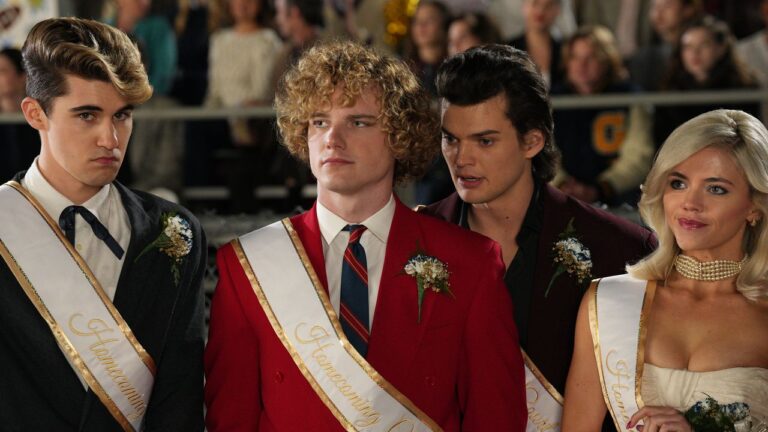
In Ryan Murphy’s television adaptation of Bret Easton Ellis’ novel The Shards, a show saturated with 1980s aesthetics—distant parents, Satanic Panic fears, early MTV hits, and a serial killer subplot—hair becomes yet another vehicle for period authenticity and character development. Episode 6, titled “Homecoming Part One,” centers on the pivotal transformation of Rhonda, a classmate and kidnap survivor who becomes the subject of a carefully orchestrated beauty intervention by two wealthy high school students at Los Angeles’ Buckley Prep.
Heading the hair department is Valerie Jackson, a nine-time Emmy nominee who worked to steer the show away from caricature while still honoring the decade’s most recognizable styles. The creative team wanted to avoid the trappings of stereotypical 1980s hair—the shellacked claw bangs and aggressive perms that typically dominate period recreations and skew closer to the decade’s later years. A few exceptions were made for specific moments. Debbie, played by Hayes Warner, and Rhonda each wear crimped hair in earlier scenes before their respective transformations, but the makeover sequence required a softer approach.
The Homecoming Transformation
Rhonda’s makeover unfolds as a carefully choreographed moment in the episode. Debbie and her best friend Susan—played by model Kaia Gerber, who portrays the valedictorian and class president—set out to give Rhonda a makeover specifically designed to position her as a viable homecoming queen candidate. “Your beauty is maybe more… severe… maybe even feral,” Debbie tells a hesitant Rhonda. “Like in a European way.”
To the backing track of Lionel Richie’s “Lady,” the two friends work on Rhonda’s hair using tools pulled from Debbie’s ornate pink vanity, including Miss Breck and Rave hairsprays alongside an array of curling implements. The goal is to soften Rhonda’s naturally straight, long dark hair into a cascade of bouncy curls—twisted up on one side and tucked behind the other ear, finished with feathered bangs that would read as quintessentially 1980s. Jackson explains the creative choice: “Since Debbie and Susan are doing the makeover, her new style is a little more reminiscent of something that they would have worn.”
Yet despite the visible curling irons on screen during filming, Jackson used Hot Sticks, the flexible electric rollers manufactured by Conair, to create Rhonda’s actual curls. “Every hairstyle on the show is either a blow dry with a hairbrush or with Hot Sticks,” Jackson states. “Rhonda got her little makeover with Hot Sticks.”
That commitment to historical accuracy extended to hairspray selection—but with one notable absence. While Aquanet appears prominently displayed on Debbie’s vanity as a visual prop, Jackson ruled out using it in actual hair work. The irony of avoiding the most famous ’80s hairspray of them all underscores her methodical approach to period authenticity, consulting with props coordinators to ensure that every visible product matched the era.
Susan: The Effortless Blonde
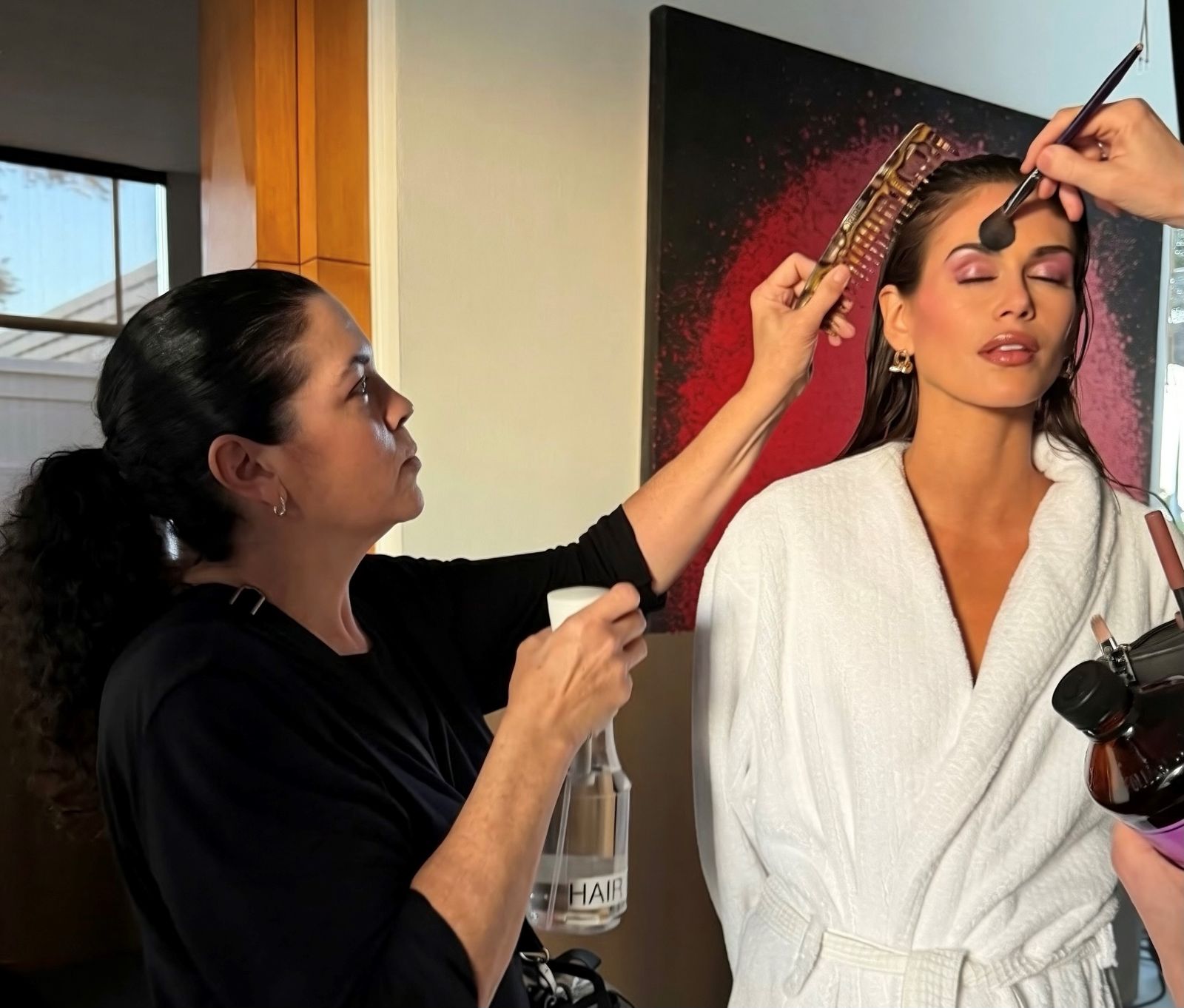
Kaia Gerber’s Susan represents a different hair philosophy: the girl who appears to achieve perfection without effort. Her long, side-parted waves remain consistent throughout the nine-episode season, styled to look like they could be her natural texture—inviting viewers to speculate whether she has maintained a perm or simply possesses enviable genetics. Jackson credits Hot Sticks for the silky texture, which required careful styling and maintenance to preserve Susan’s polished appearance as she navigates the school day.
The Crawford Connection
Jackson didn’t have to search far for styling inspiration. Gerber’s mother, Cindy Crawford, has worn similar styles throughout her career, and the two discussed this connection frequently during production. Crawford had been a longtime client of Stephen Knoll, a New York City salon that shaped her iconic looks beginning in the 1990s. Gerber, who uses Knoll’s products herself, connected Jackson directly to the salon, and its offerings became the de facto styling product line for the entire series.
Jackson describes her vision for Susan’s hair: “I wanted the audience to be able to look at her hair and feel like that is her natural texture—does she have a perm?—and then just get lost in how beautiful it looked.” The side-swept, pinned-back waves signal Susan’s position as the effortlessly accomplished student, though Jackson notes that maintaining this look required consistent work behind the scenes.
Hair as Character Marker
In episode four, when events around Debbie—a dance competition, romantic insecurity, and a serial killer’s reign of terror across Los Angeles—threaten to destabilize Susan’s ordered world, her hairstyle shifts. She adopts a middle part and explores a more mature styling approach, a visual signal of her expanding horizons beyond the high school hierarchy. When she competes in a televised dance-off competition reminiscent of Dance Party USA, Susan’s hair reflects her ambition outside the school structure. “She does want to win dance-off,” Jackson explains. “When she’s in school, she doesn’t necessarily want to be homecoming queen, but she does have other aspirations outside of just being class president.”
Notably, Susan doesn’t just compete—she wins, stealing both the spotlight and Debbie’s signature style in the process.
Debbie: Rebellion in Platinum
Debbie’s hair tells a different story: one of privilege, rule-breaking, and careful construction. The character, an aspiring actress with a film-producer father and a former beauty queen mother, sports a platinum blonde shoulder-length cut that deliberately showcases its artificiality. Visible dark roots at the base underscore her privileged status—she can afford to maintain this demanding look and let the evidence of upkeep show without consequence. “Her hair is not supposed to appear to be natural. She is coming from a wealthy family, so it is supposed to at least appear like it’s healthy,” Jackson explains.
The platinum shade was specifically inspired by Debbie Harry of Blondie, though Jackson also drew from other ’80s icons when styling Warner’s hair. Michelle Pfeiffer in Scarface, Diane Lane, and Brooke Shields all provided reference points for different styling choices, particularly when Debbie wore her hair up. Jackson adjusted Warner’s already-bleached hair to match the icier platinum tones of the early 1980s, cutting the front layers to feather naturally with a standard blow-out technique.
In episode four, as Debbie experiences vulnerability around her romance and her competitive ambitions, her hair shifts to a side part—a subtle visual cue of a softer, more exposed version of herself. When she’s fully committed to winning the dance competition, her trademark style returns in a more voluminous iteration. The consistency and evolution of Debbie’s hair underscore her as a character driven by image and status, yet capable of moments of genuine uncertainty.
Robert: The Enigmatic New Student
As the seniors enter their final year, a mysterious new classmate arrives: Robert, played by Homer Gere, son of Richard Gere, whose own mullet remains influential in contemporary haircut trends. Robert’s hairstyles shift throughout the season, reflecting his enigmatic nature and the growing uncertainty around whether he might be the serial killer stalking Los Angeles.
Jackson notes that Gere possesses remarkably silky hair—an advantage when creating the character’s various looks. Robert first appears at a screening of Stanley Kubrick’s The Shining, where Murphy’s vision called for a distinctly slicked-back style evoking mysterious villains and ’80s heartthrobs. Jackson researched extensively, drawing inspiration from bands like A-ha, whose lead singer’s hairstyle became shorthand for a particular kind of threatening allure.
As Robert integrates into the friend group, his appearance softens slightly. His school-day look shifts to a feathery side part, styled to blow in the wind and reveal a more vulnerable dimension. Yet as he becomes more immersed in the group’s dynamics, his slicked-back style returns with increased volume and intentionality—a visual representation of him investing more effort into his appearance and his social positioning. Contemporary mousse formulations provided the foundation for Robert’s voluminous look, paired with round-brush blow-outs and generous hairspray application to lock everything in place.
The Technical Reality Behind Period Hair
One of Jackson’s key decisions involved rejecting the most visually obvious tool of 1980s hairstyling: the hot curling iron. While these heated tools produce the tight curls often associated with the era, they actually close the hair’s cuticle and prevent the fluffier, more natural-looking textures that dominated actual 1980s styling. The Hot Sticks flexible rollers, by contrast, created textures that matched photographic and video evidence of the period while being kinder to the hair itself.
Balancing Visible and Working Products
Jackson’s commitment to product authenticity mirrors this technical philosophy. Every visible product on set was sourced to match the era—Miss Breck and Rave hairsprays for Rhonda’s makeover—but Jackson’s working products came from contemporary formulations of 1980s staples like Stephen Knoll’s line, which delivers the performance characteristics of vintage products without the harshness. The single exception to visible period authenticity was Aquanet, which appeared as a prop but never touched any cast member’s hair.
The Heavy Hand of Hairspray
Hair spray played an outsized role in maintaining these styles, a reality that Jackson leans into rather than minimizes. “Everyone was hairsprayed to high heaven,” she notes. “A lot of times, I did not need to redo anybody because their hair would stay because of so much hairspray.” In this way, The Shards’ hair styling captures not just the look of the 1980s, but the actual labor-intensive, spray-dependent process that maintained these styles throughout the day.
Frequently Asked Questions
Why didn't Jackson use hot curling irons if they were popular in the 1980s?
Hot curling irons close the hair's cuticle, preventing the natural, fluffy texture that actually characterized 1980s styling. Jackson used Hot Sticks flexible rollers instead to achieve the correct look without damage.
What products did Jackson actually use on cast members' hair?
Jackson used Hot Sticks rollers, blow-dry techniques with hairbrushes, and Stephen Knoll products and hairsprays. While Aquanet appeared on Debbie's vanity as a prop, Jackson never used it on any cast member's hair.
How does hair change show character development for Susan in the series?
In episode four, Susan shifts from her signature side part to a middle part and more mature styling when exploring ambitions outside of high school hierarchy. This change signals her expanding horizons beyond being class president.
