
Key takeaways
- Peptide serums like SkinMedica TNS Advanced+ and SkinCeuticals P-Tiox deliver growth factors and neuropeptides that boost collagen while targeting expression lines.
- Retinoid options range from gentle 0.3% retinol formulas to progressive strength systems like Medik8's six-step approach, with tretinoin as the most effective prescription option.
- Supporting ingredients like PDRN hydration, lactic acid exfoliation, and ceramides work best when layered strategically—retinoids on active nights, PDRN on recovery nights.
- No topical serum fully erases wrinkles, but combining consistent at-home use with occasional professional treatments extends results and addresses deeper lines.
Wrinkles form through both internal and external factors. Starting in your twenties, your skin’s production of collagen and elastin—proteins responsible for firmness and bounce—begins to slow. “Skin becomes thinner and drier, leading to the formation of fine lines and wrinkles,” says Morgan Rabach, MD, a board-certified dermatologist in New York City. UV rays, particularly UVA, accelerate this process further. While professional treatments like Botox, fillers, and radiofrequency microneedling deliver faster results, topical serums offer a gentler at-home option. Serums work by delivering higher concentrations of active ingredients in lightweight formulas that absorb quickly—ideal for targeting fine lines. They won’t match professional procedures, but consistent use can produce noticeable improvements.
How Skin Ages and Why Serums Help
The cellular cause of fine lines
As collagen and elastin production slow, skin loses its ability to bounce back from repeated facial movements and environmental stress. Active ingredients—whether peptides, retinoids, or growth factors—work by stimulating protein production or providing temporary plumping through hydration. Understanding this mechanism helps explain why certain ingredients outperform others for wrinkles.
Why lightweight formulas penetrate deeply
Serums pack active ingredients into formulations that absorb quickly without leaving residue, allowing faster penetration than heavier creams. This quick absorption makes serums ideal for layering other products and building a targeted routine.
Peptide-Based Serums for Fine Lines
Peptides function as signaling molecules that communicate with skin cells to boost collagen and elastin production or relax repetitive facial muscle contractions.
SkinMedica’s TNS Advanced+ Serum has earned favorite status among editors and dermatologists. Its proprietary TNS-MR (Tissue Nutrient Solution) complex contains human fibroblast conditioned media—a nutrient-rich liquid with growth factors, cytokines, and proteins that trigger skin repair and renewal. The dual-chamber bottle houses two treatments: the TNS-MR complex paired with peptides, flaxseed, and green microalgae, dispensed in one pump. Dr. Rabach notes that “regular use can lead to significant improvements in skin firmness, texture, and hydration, ultimately helping to prevent and reduce the appearance of wrinkles.” Jenny Bailly, executive beauty director, observes that she receives frequent compliments on her skin when using it consistently.
L’Oréal Paris’ Revitalift Triple Power Tri-Peptides Age-Defying Serum combines three peptides targeting aging from different angles. Matrixyl (palmitoyl tripeptide-1 and palmitoyl tetrapeptide-7) supports firmer skin; Argireline (acetyl hexapeptide-8) targets expression lines; carnosine provides antioxidant protection. Sodium hyaluronate draws moisture to soften lines, ascorbyl glucoside brightens, and capryloyl salicylic acid (LHA) refines rough texture.
SkinCeuticals P-Tiox Serum won a 2025 Allure Best of Beauty Award. Its neuropeptides target expression lines from repetitive facial movements, particularly around the mouth and eyes. Jessica Cruel, Allure editor in chief, uses it for smile lines and reports that filler lasts longer with regular application. The formula delivers radiance through 5% niacinamide and antioxidant laminaria extract, while 5% gluconolactone (a sensitive-skin-friendly PHA) gently resurfaces. Shannon Humphrey, MD, a board-certified dermatologist based in British Columbia, notes that “from the first application, skin takes on a natural, healthy glow that never looks shiny or greasy.”
The Ordinary’s Argireline Solution 10% offers a minimalist approach with Argireline alone, interfering with signaling involved in repetitive muscle contractions. While it decreases contraction similarly to Botox, it doesn’t match injectable results. The water-based formula lacks retinoids, acids, and oils, making it simple to layer.
Understanding peptide action
Peptides work by triggering collagen and elastin production or relaxing muscle contractions. Some, like Argireline, focus on reducing repetitive movements; others, like Matrixyl, support structural proteins broadly.
Adding radiance alongside wrinkle reduction
Formulas like SkinCeuticals P-Tiox layer in brightening ingredients alongside peptides, addressing dull skin while reducing fine lines. This dual benefit improves overall skin quality and luminosity.
Budget-friendly options
The Ordinary and L’Oréal offer effective peptide serums at lower price points, making peptide-focused routines accessible without premium pricing.
Retinoid Treatments—From Over-the-Counter to Prescription
Dermatologists cite retinoids as the gold standard for fine lines and wrinkles. All retinoids eventually convert to retinoic acid, the form that interacts with skin cells. However, the path varies.
Prescription tretinoin is already retinoic acid, requiring no conversion—it acts immediately. Over-the-counter retinol must convert twice: first to retinaldehyde (retinal), then retinoic acid. Each conversion reduces potency, making retinal—one step from the prescription form—more compelling than standard retinol.
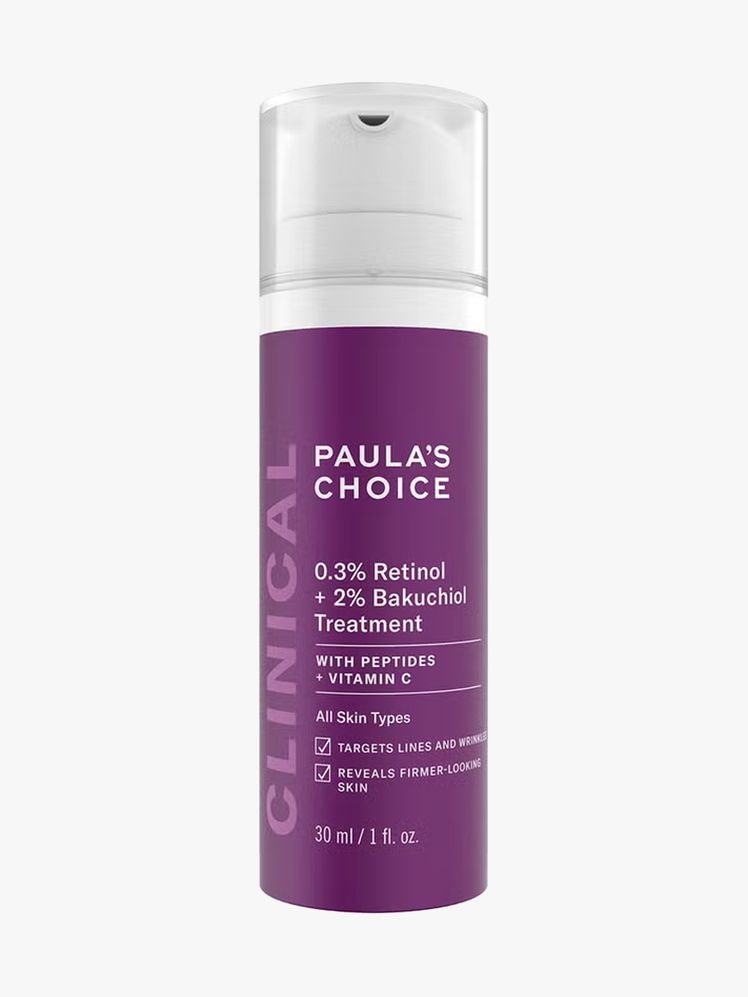
Paula’s Choice Clinical 0.3% Retinol + 2% Bakuchiol Treatment combines milder retinol with bakuchiol, a plant-derived complement. The 0.3% concentration targets fine wrinkles, uneven tone, and rough texture without the intensity of the brand’s Clinical 1% formula. To support the barrier (which retinol can irritate), it includes ceramides, soothing oat and allantoin, and palmitoyl hexapeptide-12 for elasticity. Matrixyl 3000 targets wrinkles while tetrahexyldecyl ascorbate adds antioxidant benefits. The serum is fragrance-free.
Medik8’s Crystal Retinal Serum removes guesswork with six progressive strengths: 0.01% retinal in Crystal Retinal 1 up to 0.24% in Crystal Retinal 24. Connie Yang, MD, a board-certified dermatologist in New York City, explains that “whether you’re new to retinols, have sensitive skin, or are an experienced retinoid user, there’s an option for each person.” This system allows starting gently and advancing as tolerance builds. Shanna Shipin, senior commerce director, started with the lowest dose for sensitive, eczema-prone skin and found it less drying than other vitamin A serums.
Why retinoids are most effective
Retinoids are the most evidence-backed anti-wrinkle ingredients in topical form, working by increasing cell turnover and stimulating collagen production—addressing wrinkles more deeply than peptides or hydrating ingredients alone.
Progressive strength system for tolerance building
Multiple strengths allow skin to adapt gradually. Starting low and advancing as tolerated minimizes irritation and dryness while building to stronger concentrations.
Hydration and Barrier Support
Rejuran’s Turnover Ampoule c-PDRN 0.5% Renewing Serum pairs 0.5% salmon-derived c-PDRN with glycerin and sodium hyaluronate for moisture. This hydration particularly helps mature skin, since dryness exacerbates fine lines. The formula includes niacinamide, licorice root extract, and arbutin for dark spots, plus calming ingredients: aloe, calendula, and bisabolol.
Jane Yoo, MD, a dual board-certified dermatologist based in New York City, says this formula “improves hydration and barrier resilience, especially alongside stronger actives.” However, Dr. Yoo considers topical PDRN an adjunct rather than a replacement for proven wrinkle ingredients. PDRN “does not have the same level of evidence as retinoids and SPF for photoaging.” It works best on non-retinoid nights or under moisturizer, supporting skin recovery.
PDRN’s role in skin recovery
PDRN helps dry skin feel more comfortable and aids post-irritation recovery when layered with stronger actives, particularly useful for those irritated by retinoids or exfoliating acids.
Gentle Exfoliation for Texture
Biossance’s Squalane + 10% Lactic Acid Resurfacing Serum addresses wrinkles by improving texture and cell turnover. Squalane functions similarly to sebum, balancing the barrier without clogging pores. Lactic acid provides gentle exfoliation—at 10% concentration, its large molecule size prevents deep absorption, suiting sensitive skin. Paul Jarrod Frank, MD, a board-certified dermatologist in New York City, calls it “a fantastic product for those looking for gentle exfoliation that can improve texture, brighten dull complexion, and help with cell turnover.” Howard Sobel, MD, a board-certified dermatologist in New York City, particularly recommends it for crow’s feet.
Realistic Results and Professional Guidance
No serum will completely erase wrinkles. “There is no face serum or cream in an over-the-counter skin-care routine that will single-handedly remove or erase wrinkles,” says David Kim, MD, a board-certified dermatologist in New York City. Some ingredients like tretinoin can make wrinkles appear softer.
Many benefit from combining serums with professional treatments. Jessica Cruel layers SkinCeuticals P-Tiox with filler, noting it extends longevity. Others alternate peptide and retinoid serums on different nights, or apply PDRN on recovery nights between stronger treatments.
Understanding the limits of topical serums
While serums are powerful, they work best within a comprehensive routine including SPF. Retinoids and peptides produce noticeable improvements but won’t match Botox or filler results.
When injectables complement serums
For many, the ideal approach combines at-home serums with occasional professional treatments. Serums maintain results between appointments and support skin health, while injectables address deeper wrinkles and dynamic lines beyond topical reach.
Frequently Asked Questions
Why do wrinkles form starting in my twenties?
Collagen and elastin production, the proteins responsible for firmness and bounce, begins to slow in your twenties. This causes skin to become thinner and drier, leading to fine lines and wrinkles. UV rays, particularly UVA, also accelerate this process.
What's the difference between retinol and retinal serums?
Retinol requires two conversions in your skin to become retinoic acid (the active form), while retinal needs just one conversion. This makes retinal more potent than retinol, which is why Medik8's Crystal Retinal option sits one step away from prescription-strength tretinoin.
Can I combine peptide serums with retinoid serums?
Yes, many people layer peptide and retinoid serums on alternating nights. You can also apply PDRN serums on recovery nights to support your barrier between stronger treatments. Jessica Cruel, for example, alternates between SkinCeuticals P-Tiox and her retinol while also using it alongside filler treatments.
