
Key takeaways
- After a BRCA diagnosis at 28, Stephanie Germino chose aesthetic flat closure over reconstruction, building community for preventative mastectomy patients questioning traditional beauty standards.
- Her partner Diana's unconditional support proved transformative, shifting Germino's focus from conforming to beauty standards to prioritizing her own bodily autonomy.
- Germino uses her platform to clarify that aesthetic flat closure following cancer-prevention mastectomy differs from top surgery, though both are life-saving procedures.
- Through social media visibility despite repeated account bans, Germino demonstrates that desirability and femininity exist independent of breast tissue.
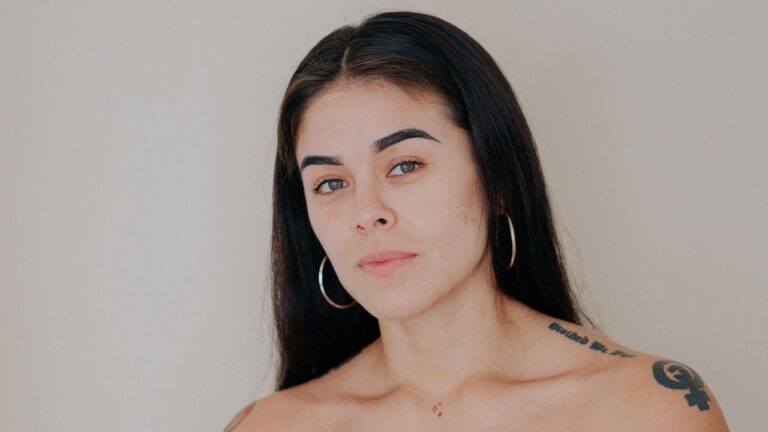
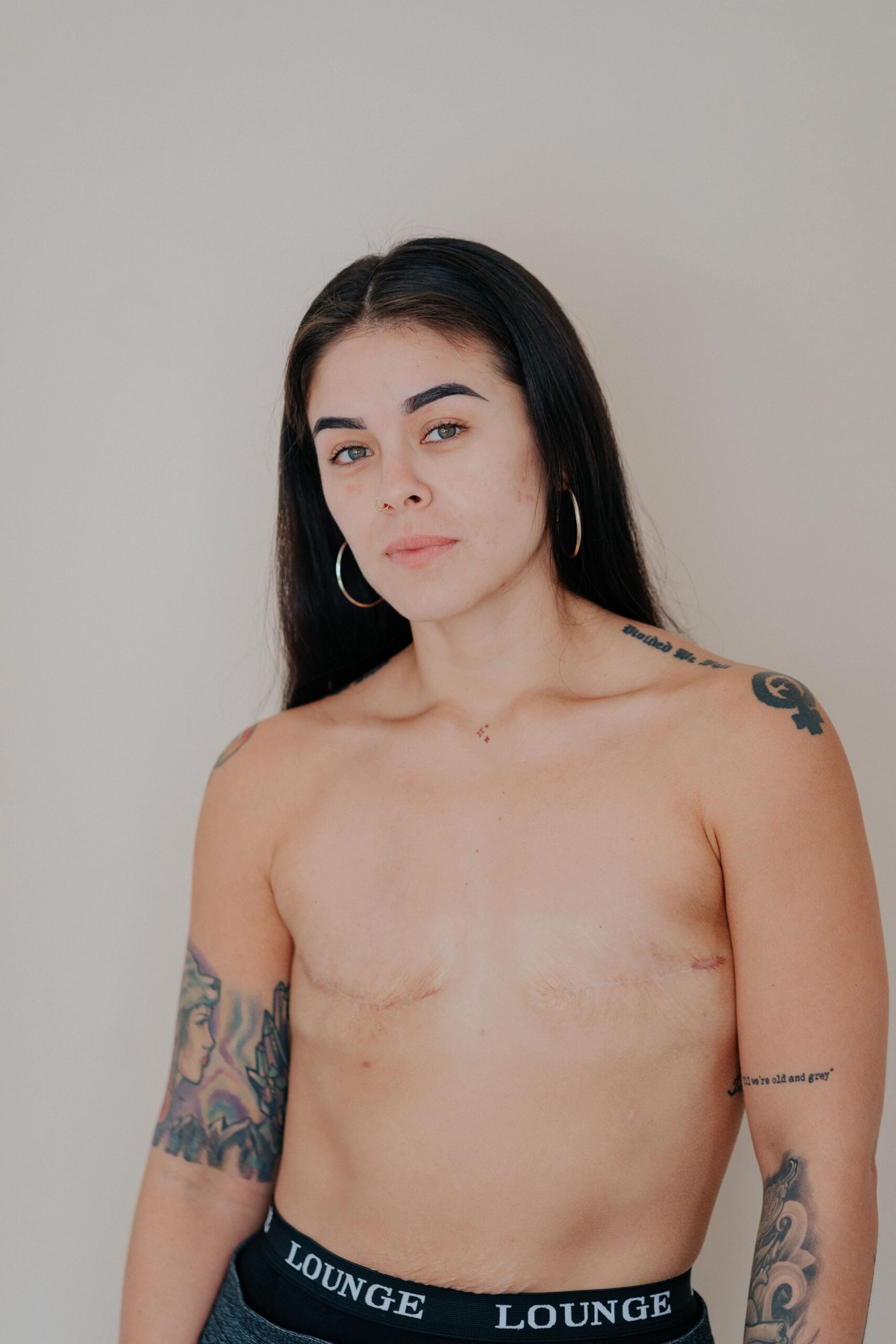
On the latest episode of Allure’s Perspectives podcast, a series examining how breasts intersect with beauty, health, identity, sexuality, and culture, host and editor in chief Jessica Cruel speaks with Stephanie Germino, a creator and advocate who operates online as @theebooblessbabe. Germino shares her decision to undergo a preventative double mastectomy with an aesthetic flat closure—a procedure that creates a smooth, flat, nipple-free chest—and how she uses her platform to advocate for bodily autonomy and breast cancer awareness.
The Cost of Visibility
Germino’s online presence comes with a persistent obstacle: platform censorship. Her topless photos and videos regularly trigger account suspensions and deletions, a reality she finds particularly absurd given the anatomy involved. “I have had my account deleted so many times,” she tells Cruel on the podcast. “I have to send so many emails, cause so much ruckus to try to get my accounts back.” The irony cuts deep—she lacks the breasts, nipples, and areolas that typically violate community guidelines, yet platforms continue to flag her content as inappropriate. “If a man can [go topless], why can’t I?” she asks. “I have less than a man.”
Despite these barriers, Germino has built a substantial following and become an outspoken advocate within the “previvors” community—people with high genetic risk for cancer who have never been diagnosed with the disease. Her advocacy centers on both cancer awareness and the choice to go flat after a preventative mastectomy.
A Family Legacy and a Different Path
Growing Up With BRCA
Germino carries the BRCA gene mutation, which significantly increases the likelihood of developing cancer. Her mother and aunt both tested positive for the same mutation and underwent preventative double mastectomies and hysterectomies when Germino was younger. Yet they chose a different route post-surgery: both opted for breast reconstruction.
As a child, Germino recalls misunderstanding what their diagnosis meant. She thought having BRCA simply meant insurance would cover cosmetic breast augmentation. She internalized the cultural message that femininity required long hair and large breasts—a standard reinforced by her family’s adherence to traditional gender roles. “It’s easy to stay in that cycle [of misogyny] if everybody has that same mindset,” she reflects in the podcast.
The Turning Point
At 28, Germino tested positive for BRCA herself. This time, she chose a path neither her mother nor her aunt had taken: she opted for a preventative double mastectomy followed by an aesthetic flat closure instead of reconstruction, becoming what she calls a “flatty.” Since testing positive, she has undergone three surgeries and two revisions as part of her journey.
The discovery of the flatty community on TikTok shifted her perspective entirely. Seeing others who had chosen AFC and were thriving without implants revealed a possibility she had never considered. “I pictured myself and how I would look [without breasts] and I’m like, ‘That’s it. That’s exactly what I’m gonna do,'” she says. Her childhood belief that “a woman needed long hair and big boobs to be beautiful” gave way to a new understanding: “femininity, womanhood, and your sexuality is not based off of what you look like.”
How Her Body Image Transformed
From a young age, Germino harbored negative thoughts about her own body, particularly her breasts. She remembers thinking, “Whenever I can, I’m gonna get my boobs done.” This self-criticism persisted through her twenties until her diagnosis forced a recalibration.
The shift became tangible after her procedure. The confidence Germino now carries springs from alignment with her own values rather than external expectations. “Anytime I can take my shirt off, I do,” she says. “I absolutely love my chest.” Her comfort in her body stands as testament to the psychological power of choice and bodily autonomy.
The Role of an Unconditional Partner
Witnessing the Alternative
Germino has heard countless stories from other patients whose partners rejected the decision to go flat. Some men told their wives they hadn’t married “a man,” framing the flat chest as a betrayal or loss. “It’s very unfortunate that that has any weight to your decision when it comes to your body,” Germino observes, recognizing how such rejection can derail someone’s autonomy precisely when they need it most.
Diana’s Response
Germino’s own partner, Diana, offered something radically different. When Germino discussed her preventative mastectomy plan, Diana responded: “You’re doing a preventative, risk-reducing surgery. I will love you no matter what.” That assurance prompted a crucial question: “Wait, why did you want implants in the first place?” Germino realized she had never really wanted them at all—she had wanted them because she believed she should want them.
Aesthetic Flat Closure Versus Top Surgery: A Critical Distinction
Germino spends considerable time on her platform clarifying the difference between an aesthetic flat closure following a mastectomy and transgender top surgery, often because people assume she is transgender and leave hateful comments. “I’m not offended when people mistake me for trans,” she says. “I love my trans homies. I am only offended because they’re spewing hate.” The distinction matters on a clinical level.
In a mastectomy performed for cancer risk reduction, the surgeon removes as much breast tissue as possible to minimize the risk of cancer developing later. In top surgery, surgeons may preserve some breast tissue to create the appearance of chest contours. Yet both procedures serve as life-saving interventions. “Both are life-saving, risk-reducing surgeries,” Germino emphasizes.
For Germino, the mastectomy with AFC proved gender-affirming in ways she didn’t anticipate. When she told the surgeon performing her initial procedure that she wanted to remain flat, his response caught her off guard: “Don’t you want to be a whole woman?” She has since come to feel more feminine than ever, a reminder that femininity exists independent of breast tissue.
Why She Takes Up Space
Germino’s social media strategy has a clear aim: show that an aesthetic flat closure is a legitimate option for anyone undergoing a preventative mastectomy who doesn’t want reconstruction or implants. She carefully avoids suggesting it’s the right choice for everyone. Instead, she wants those hesitant about implants to know they have options. “My platform is about doing what you want, not what you think you should do to please others or society,” she explains.
That visibility has had measurable impact. Women message Germino to say they were hesitant about going flat until they saw her platform and gained confidence that “they can still be sexy, they can still be beautiful.” The comments section reinforces another reality: “if you take even a second to go through any of my platform comments, you’ll see men are still throwing themselves left and right every day.” Desirability, she has found, has nothing to do with breast anatomy.
Source: Allure
Frequently Asked Questions
What is an aesthetic flat closure?
An aesthetic flat closure creates a smooth, flat, nipple-free chest. It's performed as an alternative to breast reconstruction following a preventative mastectomy.
What is the difference between aesthetic flat closure and top surgery?
In a mastectomy for cancer risk reduction, surgeons remove as much breast tissue as possible to minimize cancer risk. In top surgery, surgeons may preserve some breast tissue to create chest contours. Both are life-saving, risk-reducing surgeries.
How did Stephanie Germino's family history influence her decision?
Germino's mother and aunt both tested positive for BRCA and underwent preventative double mastectomies, but chose breast reconstruction afterward. After discovering the flatty community on TikTok, Germino chose aesthetic flat closure instead of reconstruction.
