
Key takeaways
- GLP-1 medications are driving increased demand for breast lifts rather than reductions, as rapid weight loss leaves volume in the lower breast.
- Motiva implants have achieved rupture rates below 1 percent at 10 years, eliminating the need for replacement surgeries once expected at the 10-year mark.
- New aesthetic preferences favor smaller, perkier breasts like the ballerina boob and yoga boob, requiring surgeons to adjust expectations during consultations.
- AI chatbots help patients prepare for consultations, but AI-generated inspiration images often misrepresent what is surgically achievable.
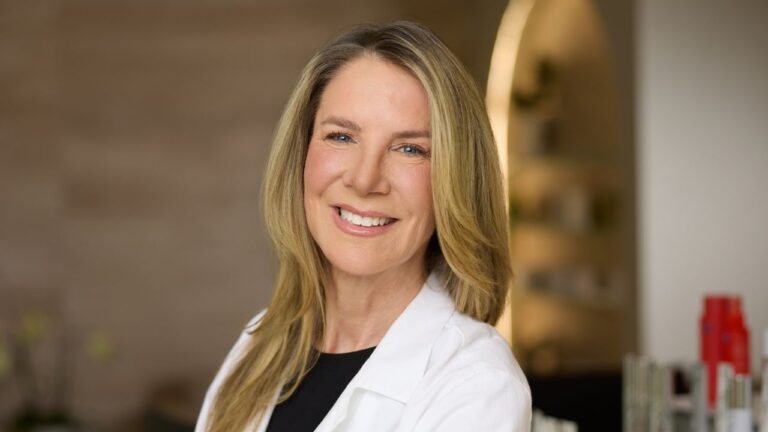
GLP-1 prescriptions like Wegovy and Zepbound, originally developed for diabetes management, have surged in popularity, fundamentally altering the composition of Dr. Cassileth’s patient base. As the first female chief of plastic surgery at Cedars-Sinai Medical Center and a surgeon renowned for reconstructive work, Dr. Cassileth has a front-row seat to how these shifts are changing what patients want and what is now possible to deliver.
The GLP-1 Effect on Breast Surgery
The impact on surgical demand has been substantial. Patients using these drugs consistently report weight loss ranging from 20 to 30 pounds, and that loss distributes unevenly across the body.
Why Breast Shape Changes With Rapid Weight Loss
When someone loses significant weight, their breasts often do not shrink proportionally. Instead, the tissue that remains sags downward, leaving the upper half of the breast deflated while volume pools in the lower portion. This creates a technical challenge: the patient may have the breast size they want, but positioned in exactly the wrong spot. The skin, stretched from years of carrying a larger frame, has lost its natural elasticity and can no longer tighten on its own.
The Shift From Reductions to Lifts
This reality has rippled through Dr. Cassileth’s scheduling. Requests for breast reductions have dropped noticeably, while lift procedures are climbing. The distinction matters: a reduction removes tissue altogether, while a lift repositions what is already there. For GLP-1 patients, that repositioning is the goal.
Surgical Innovation: Absorbable Mesh in Breast Lifts
The traditional approach to breast lifts relied entirely on tightening the skin to provide support and shape. But when skin has been stretched and compromised by weight fluctuations, that strategy fails. You cannot trust degraded tissue to hold the shape you have created.
Dr. Cassileth has adopted a newer technique using absorbable mesh, a material that solves this problem. The mesh is implanted to hold the breast in its new position while the body gradually breaks it down over time. As it dissolves, scar tissue and natural collagen replace it, creating a permanent structure independent of skin elasticity. This shift in approach has opened possibilities that skin-only lifts could not achieve: surgeons can now sculpt breasts into virtually any shape a patient requests, regardless of the underlying skin quality.
The Ballerina Boob and Yoga Boob Trends
Aesthetic preferences in breast shape are cyclical, much like every other beauty trend. Right now, patients are moving away from the large, round silhouette that dominated the 2000s and 2010s. Instead, they are asking for smaller, perky breasts.
Two specific shapes have emerged with their own names. The “ballerina boob” features minimal tissue that sits high, concentrated just under the areola, creating an elegant line that flatters certain clothing. The “yoga boob” takes the opposite approach: it maintains volume but drops it forward, creating a rounded scoop at the bottom with minimal fullness at the top.
Dr. Cassileth is careful during consultations to remind patients that these shapes will not look identical on every body. A breast of a certain size that looks perfect on a celebrity may look completely different on someone with a different frame, shoulder width, or chest wall shape. Managing expectations before surgery is crucial.
Motiva and the New Generation of Implants
Implant technology has advanced substantially in recent years, and one device in particular is reshaping outcomes: the Motiva implant, which received an Allure Best of Beauty Breakthrough Award in 2025. The innovation centers on a feature called “nano texture,” a microscopic surface treatment that changes how the body interacts with the implant.
Before this generation of implants, rupture was an accepted risk of the procedure. Surgeons told patients to expect that roughly half of all implants would rupture within 20 years, and at the 10-year mark, at least 10 percent would have failed. Those numbers were grim enough that many women approached breast augmentation as an eventual replacement surgery rather than a one-time procedure.
Motiva implants have a dramatically different track record. Their decade-plus presence in Europe shows rupture rates below 1 percent at the 10-year mark, fundamentally changing expectations about implant longevity. That nano texture surface lowers the risk of the body recognizing the implant as a foreign object and forming scar tissue around it, a condition called capsular contracture that can make implants feel hard or look unnatural. The result is that surgeons no longer need to schedule automatic replacement appointments. Instead, patients simply monitor the implant over time and watch for any changes.
AI as a Consultation Tool
Preparation and Research
Dr. Cassileth’s patients increasingly arrive for their first appointment having already researched their options online, often using AI chatbots like GPT to prepare questions. This has genuinely improved the consultation experience: patients come prepared with knowledge, ask more specific questions, and have more realistic expectations before they sit down with the surgeon.
Managing Expectations With Visualization
However, AI has also introduced a complication. Where patients once brought airbrushed celebrity photos as inspiration, many now bring AI-generated images as examples. These fake images are far divorced from what is actually achievable, and Dr. Cassileth has to redirect conversations away from them. She uses AI-powered visualization tools in her own practice to show realistic outcomes specific to each patient’s anatomy, but she advises against patients attempting the same with general-purpose AI at home.
The Pendulum of Fear and Excitement
Sentiments around breast implants have historically swung between two poles. Fear emerges whenever news surfaces about implant safety, particularly concerns about anaplastic large cell lymphoma, an extremely rare cancer linked to textured implants. When these stories circulate, patients rush to remove their implants, and removal surgeries spike.
Then a celebrity announces augmentation, or new technology arrives, and excitement replaces fear. The pendulum swings the other direction. In Dr. Cassileth’s career alone, the market has cycled through three complete rotations of removal and renewed demand. Understanding this psychology helps surgeons anticipate which patients are genuinely interested in improvement and which are reacting to headlines. Right now, the pendulum sits in an excitement phase, driven by technology advances and the changing body shapes emerging from widespread GLP-1 use.
Frequently Asked Questions
What is the ballerina boob trend?
The ballerina boob is a small breast shape with minimal tissue concentrated just under the areola, creating an elegant silhouette.
How has the Motiva implant changed surgical outcomes?
Motiva implants have a nano-textured surface that reduces capsular contracture and rupture risk. They have achieved less than 1 percent rupture at 10 years in European use, eliminating the need for automatic replacement surgeries.
Why are breast lifts increasing for GLP-1 patients?
GLP-1 patients lose 20-30 pounds, but the weight loss distributes unevenly. Breast tissue sags downward while the skin, stretched and inelastic, can no longer support it, making lifts necessary to reposition the tissue upward.
