
Key takeaways
- Peptide serums support hair health and density but cannot replace proven treatments like minoxidil for diagnosed hair loss.
- The best formula for you is one you'll use consistently for at least three to six months—no single option works for everyone.
- Application strategy matters: apply scalp serums in sections for curly hair, and pair strand-repair treatments with scalp formulas for damaged hair.
Peptide serums have gained considerable attention as potential solutions for thinning hair, yet they occupy a specific niche in hair-care science. These products can help reduce shedding and make hair appear fuller and stronger over time with consistent use, but they are not the hair-growth cure that some social media claims suggest. Board-certified dermatologist Whitney Hovenic, MD, from Reno, Nevada, explains that peptides are short chains of amino acids functioning as signaling molecules that communicate with hair follicles and scalp cells, potentially supporting follicle activity and improving the scalp environment for healthy growth.
The critical distinction lies in thinking of peptides as supporting players rather than primary treatment agents. “Think of them as boosters—best used early or alongside other treatments,” Dr. Hovenic notes. They show promise for early-stage thinning, shedding caused by stress or hormonal fluctuations, and as preventive measures. However, they are not effective as standalone solutions for advanced hair loss or scalp diseases where follicles have become dormant. This means peptide serums cannot replace clinically validated hair-loss treatments such as minoxidil.
Understanding Peptide Mechanisms
When peptides are applied to the scalp, they send specific signals that differ depending on the compound used. Acetyl tetrapeptide-3, for example, reinforces the connective matrix anchoring hair at the root. Other peptide types extend the growth phase of the hair cycle or promote broader follicle function. The result is a healthier follicle environment—but one that remains supportive rather than curative. Board-certified dermatologist Aderonke Obayomi, MD, from New York City, emphasizes this distinction: “Overall, peptides for hair growth are best thought of as supportive ingredients that can create a healthier scalp environment rather than a standalone treatment.”
For diagnosed conditions like androgenetic alopecia, the gold standard treatments remain minoxidil, finasteride, and in-office procedures including PRP or low-level laser therapy. While peptides might complement these approaches, they cannot substitute for them.
Multi-Mechanism Formulas
Layered Peptide Complexes
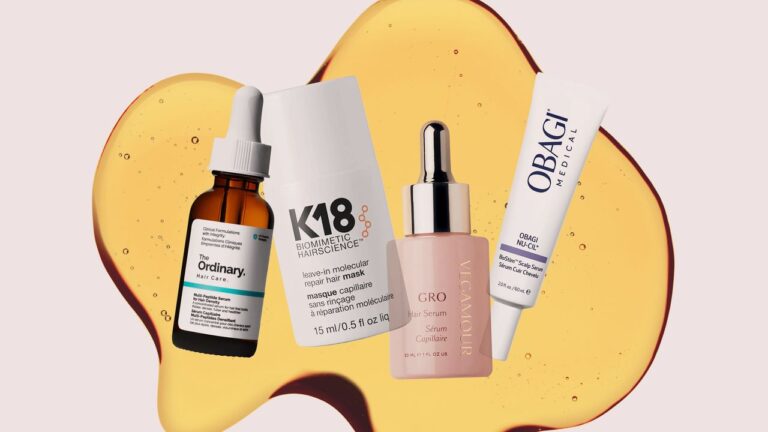
The Ordinary’s Multi-Peptide Serum for Hair Density combines four trademarked ingredient complexes targeting different biological pathways. Redensyl pairs larch wood and green tea leaf extracts with amino acids to establish a healthy follicle environment. Procapil delivers biotinoyl tripeptide-1 alongside botanical compounds that strengthen follicles and secure hair at the root, while Capixyl pairs acetyl tetrapeptide-3 with red clover extract to create denser-looking hair. The formula also includes Baicapil, composed of baikal skullcap (a flowering plant native to East Asia), wheat germ, and soybean germ extracts designed to support a healthy hair-growth cycle. Board-certified dermatologist Dara Spearman, MD, from Fort Wayne, Indiana, points out that this multi-technology approach “supports the appearance of fuller hair from several biological pathways.”
The formulation adds caffeine and green tea extract, making it “a well-rounded option that targets density, shedding, and overall scalp health,” per Dr. Hovenic. Its water-based texture absorbs quickly without greasy residue, allowing easy daily use across hair types. Dr. Obayomi highlights the fragrance-free formula and “credible multi-mechanism approach at an accessible price point.”
Addressing Strand Thinning
Ponytails can look thinner not just from increased shedding but from individual strands becoming finer—a consequence of aging, hormonal changes, and genetics. The Obagi Medical Nu-Cil BioStim Scalp Serum addresses this by pairing biotinoyl tripeptide-1 with amino acids and scalp-nourishing ingredients: caffeine, niacinamide, panthenol, ginseng, and pumpkin seed extract. Dr. Spearman explains the strategy: “The idea behind the formula is to create a healthier scalp environment around the follicle while helping fortify strands at the root.”
Vegamour’s Gro Hair Serum approaches elevated shedding through peptides plus plant ingredients. Its formula combines three bioengineered peptides and polypeptides—produced using Nicotiana benthamiana, a plant used to manufacture recombinant proteins—with red clover and mung bean sprout extracts, caffeine, and biotin. The water-based texture absorbs quickly without leaving scalp grease, supporting consistent daily use. Dr. Obayomi recommends it for early thinning or diffuse shedding, while cautioning: “It’s not a replacement for minoxidil in clinically significant hair loss, but as an adjunct or for someone not yet ready for minoxidil, it’s a reasonable starting point.”
Specialized Formulas for Damage and Dryness
Neutrogena’s Hair Restore Serum spotlights acetyl dipeptide-31 amide, a less common peptide in scalp serums. Being a dipeptide—a chain of just two amino acids—it is relatively small and “may penetrate the layers of your hair more easily,” says Dr. Obayomi. The water-based formula combines this peptide with caffeine, niacinamide, arginine, hydrolyzed collagen, and bisabolol. Its lightweight, non-greasy texture prevents buildup, benefiting easily irritated scalps. The fragrance-free formula eliminates another irritation risk. Drugstore availability plus affordable pricing matter: “Price point impacts whether patients will actually stay consistent with a daily scalp serum, since results require months of use,” Dr. Obayomi notes.
K18’s Leave-In Molecular Repair Hair Mask, which won the Readers’ Choice Award in 2024, differs by working inside damaged strands rather than on the scalp. The active ingredient is sh-oligopeptide-78, the peptide behind K18’s patented K18peptide technology—a biomimetic peptide whose amino-acid sequence mimics the keratin proteins comprising hair. “It’s particularly useful for people recovering from bleach, color, or heat damage,” Dr. Obayomi explains. Hydrolyzed wheat protein and wheat starch provide additional conditioning and temporarily reinforce compromised hair. Application requires attention: emulsify the product between your hands, apply, wait a few minutes, then continue styling, and do not apply conditioner beforehand. Senior commerce director Shanna Shipin describes the transformation: “I put my hair through so much—the blow-drying, the flat-ironing, the re-curling!—my split ends were practically visible from outer space. It wasn’t until I diligently started using this leave-in mask that I believed you could actually undo years of damage. There’s a learning curve to using it; you need to essentially emulsify the product in your hands, then apply and wait a few minutes, and then continue to style. After consistent use for a month, people noticed my hair was shinier when blown out, and my curls were brought back to life; their pattern restored, their joie de vivre revived.”
Briogeo’s Destined for Density Peptide Hair Serum targets dry scalps with dual moisture. Humectants—glycerin, propanediol, betaine, aloe, and panthenol—attract and retain water, while emollients including coffee seed, meadowfoam, sea buckthorn, and jojoba oils soften and condition. Better-lubricated hair experiences less friction during brushing and styling, potentially reducing tangling and mechanical breakage. The formula contains copper tripeptide-34, a copper-bound peptide that fosters a healthier scalp environment, plus caffeine, niacinamide, ginseng, and biotin. Dr. Hovenic notes the formula is “fragrance-free and designed with sensitive or reactive scalps in mind, minimizing the risk of redness or buildup” despite its rich ingredient profile.
Application Across Hair Types and Life Stages
Peptides function the same way regardless of hair type, but application strategy differs. For curly or textured hair, Dr. Obayomi recommends lightweight, water-based serums applied directly to the scalp in sections to protect your curl pattern and styling, while fine or oily hair benefits from nongreasy, fast-absorbing formulas. For dry or damaged hair, combining a scalp-focused peptide serum with a strand-repair peptide treatment addresses both concerns.
During pregnancy and breastfeeding, peptides themselves carry minimal risk because they are large molecules with low systemic absorption. However, since hair serums contain caffeine, acids, botanicals, and other active compounds, Dr. Obayomi recommends reviewing the entire ingredient list with your ob-gyn before starting a new product. One clear exception: avoid serums containing minoxidil during pregnancy and breastfeeding.
Layering, Safety, and Professional Care
Peptide serums can be combined with other hair-growth products, including minoxidil, because they operate through different mechanisms. Minoxidil boosts blood flow to stimulate growth, while peptides enhance follicle health and longevity. Dr. Hovenic suggests separating topical treatments—using a peptide serum in the morning and minoxidil at night—to reduce potential interference and irritation. Peptide serums also work alongside oral hair-growth medications: when taking oral medications for hair growth, topical peptides can amplify their benefits. If treating diagnosed hair loss, check with your dermatologist before adding another product.
For most people, peptide serums are well-tolerated. Scalp irritation or contact dermatitis usually stems from other formula ingredients like fragrance or alcohol, not the peptides themselves. Patch-test any new serum on your inner arm before daily scalp use, particularly if you have sensitive skin.
Experiencing significant, rapid, or patchy hair loss warrants consultation with a board-certified dermatologist. Conditions such as telogen effluvium, traction alopecia, central centrifugal cicatricial alopecia, and thyroid-related shedding present differently and require distinct treatment plans. Realistic timelines for results span three to six months of consistent daily use—the right formula is ultimately one you will actually use regularly.
Frequently Asked Questions
Can I use a peptide serum if I'm taking minoxidil?
Yes. Peptide serums work through different mechanisms than minoxidil and can be used together. Dermatologists recommend separating topical treatments—using peptides in the morning and minoxidil at night—to minimize potential interference and irritation.
Is it safe to use peptide serums during pregnancy?
Peptides themselves are large molecules with minimal systemic absorption and are generally considered low-risk. However, hair serums contain other ingredients like caffeine and botanicals. Review the entire ingredient list with your ob-gyn before use. Avoid serums containing minoxidil during pregnancy and breastfeeding.
How long do I need to use a peptide serum to see results?
Most people need three to six months of consistent daily use to see results. The right formula is ultimately one you will actually use regularly during this realistic timeframe.
