
Key takeaways
- Searches for petrichor fragrances surged 94.4% year-over-year, with consumers craving scents that evoke rain on dry earth during hot summers.
- Petrichor, the scent created when raindrops release microbes from soil, remained unnamed until 1964 and wasn't isolated as geosmin until 1965.
- Perfumers rarely rely on pure synthetic geosmin due to its musky tendency, instead layering vetiver, patchouli, aldehydes, and marine notes to authentically capture rain-struck earth.
In Kannauj, an ancient village roughly 250 miles northwest of Delhi, perfume-makers have spent centuries distilling kiln-baked clay and sandalwood oil into a precious concentrate called mitti attar. The result smells like precipitation hitting dry soil—that fleeting moment when humidity meets earth at the start of a rainstorm. This scent has a name: petrichor, derived from the Greek words petra (stone) and ichor (the blood of the gods). It is specific, magical, and until recently, rarely encountered in mainstream fragrance.
The Sudden Surge in Petrichor Demand
Online searches for petrichor fragrances have spiked 94.4% compared to last year, according to market research platform Spate Data. As summer stretched on with oppressive heat, consumers began seeking scents that evoked something cooling and refreshing—an olfactory signal that relief was coming. The trend mirrors the rise of tomato-leaf fragrances: both tap into a deeper human impulse to reconnect with the natural world, particularly through memories of childhood.
Steven Gontarski, senior brand manager for niche fragrance retailer Luckyscent, has witnessed this shift firsthand. “Everyone has memories of petrichor,” he notes. “Summer vacation when you were a kid, or going on a road trip and getting caught in the rain. It’s nostalgic, and many of us are feeling a desire to go back to a more comforting time.” Beyond petrichor itself, Gontarski has observed rising interest in fragrances that suggest the smell of mushrooms, oysters, and pollen. He attributes this to a collective “touch grass” impulse—a response to digital saturation that sparks the desire to ground ourselves in the physical world. “We get so wrapped up in the digital world that we lose sight of the fact that we’re actually mammals living on Earth,” he says.
The Science Behind the Scent
How Petrichor Develops
Petrichor emerges from a precise chemical reaction. When raindrops strike soil and rocks, they release microbes living in those surfaces. Simultaneously, plants emit organic compounds that become amplified by moisture. The combination creates the distinctive scent. Notably, this reaction requires particularly parched earth to occur, which is why petrichor does not develop every time it rains—this scarcity adds to its allure and mystique.
A Recent Scientific Discovery
Though people have recognized this scent for centuries, the science is modern. Australian researchers Joy Bear and Richard Grenfell Thomas coined the term “petrichor” in 1964. The following year, scientists isolated geosmin, the specific molecule responsible for the wet-earth smell. Geosmin appears in raw beets, freshly dug soil, and damp basements. The human nose detects it at remarkably low concentrations—as few as parts per trillion.
Petrichor in Perfumery: A Brief History
The scent itself is relatively recent in fragrance composition. Before synthetic geosmin became commercially available in the early 2000s, perfumers worked around the concept rather than with the molecule itself. Guerlain’s iconic Après l’Ondée, which translates as “after the rain,” arrived in 1906 as a powdery floral meditation on post-storm air without using geosmin at all. Once perfumers gained access to synthetic geosmin, they began exploring how to use it realistically. However, geosmin presents a significant technical challenge: it skews musty when overused, requiring precision and restraint.
How Perfumers Build Petrichor Without (Always) Geosmin
Alternative Approaches
Many modern perfumers avoid pure geosmin or use it sparingly, instead building a petrichor effect through layered ingredients. Vetiver contributes a grassy quality; patchouli adds an earthy, loamy character; marine notes and aldehydes evoke the sensation of electricity-charged air and thirsty vegetation. This multi-layered approach often produces more convincing results than relying on geosmin alone.
Perfumer Philosophies
Douglas Little, founder and perfumer at Heretic, describes petrichor as “the smell of the earth exhaling. It’s not really rain. It’s what rain awakens.” He emphasizes the elements beneath the surface: dry soil, cracked roots, stone, moss, mineral dust, and microscopic life. “There is something almost prehistoric about it,” he says. His Heretic Ghost Stories collection—five scents invoking “olfactory apparitions”—weaves petrichor through liminal spaces: abandoned gardens, misty forests, dusty corridors in haunted houses. In Spectral Grace, ozonic notes shimmer over pale rose. In Shadow People, geosmin collides with oakmoss and musk, creating an almost three-dimensional texture. “Petrichor immediately changes the emotional temperature of a fragrance,” Little explains. “Instead of feeling decorative, it makes a perfume feel inhabited.”
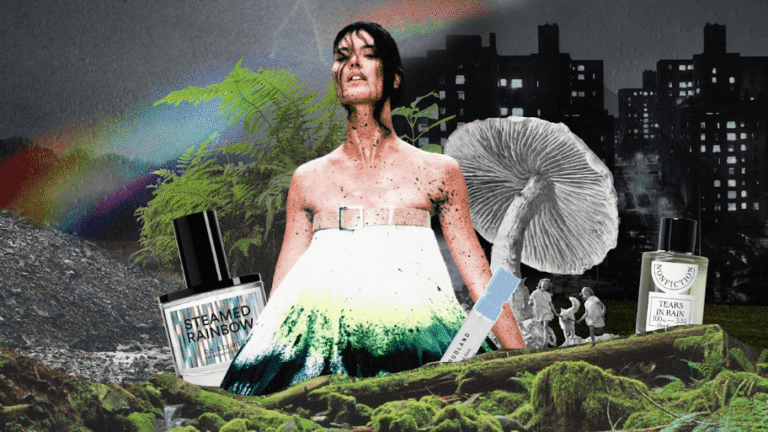
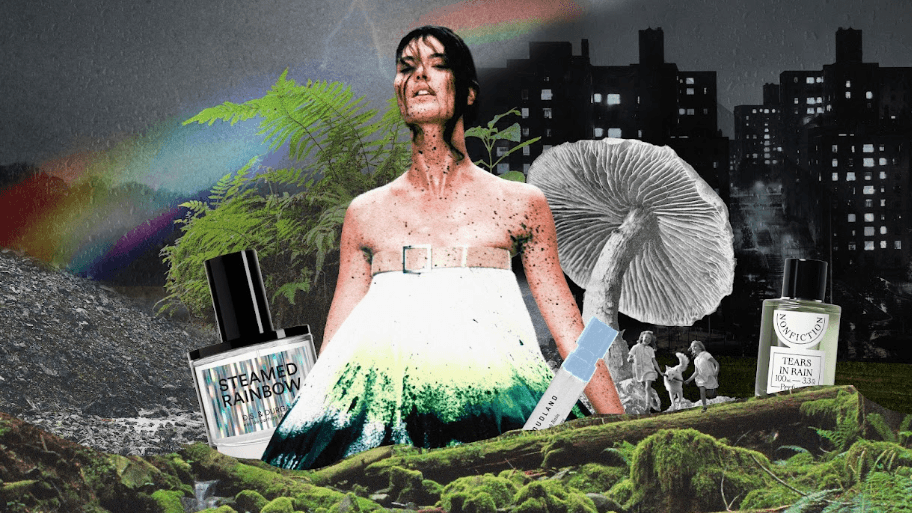
David Seth Moltz, cofounder and perfumer of D.S. & Durga, views petrichor as a brand signature and a tool for authenticity. He employed it in Concrete After Lightning and Big Sur After Rain, and crafted an aerosolized summer-shower effect in Steamed Rainbow. “Petrichor adds realness to a composition,” Moltz says. “It makes your perfume seem like you are actually in a space like a forest or by the water, not in a fantasy world just based on those places.”
Fragrances Capturing the Storm
Kevin Keller, founder and perfumer of Fulton & Roark, tapped mitti attar directly for Cloudland, inspired by a hike cut short by rainstorm. For the Korean brand Nonfiction, perfumer Yann Vasnier combined herbaceous geranium with moss and vetiver in Tears In Rain, conjuring the impression of a forest immediately after a downpour. Le Labo’s frequently praised Baie 19 captures humid air and wet leaves through juniper, ozone, patchouli, and musk. Marissa Zappas’s ethereal Petrichor employs soft, powdery iris to suggest drenched earth and flowers. L’Epoque’s moody Dreams & Nightmares couches petrichor in eucalyptus and soft amber, smelling like a cabin in the woods during a storm.
Demeter Fragrance Library, known for photorealistic scents, offers perhaps the most uncompromising takes. CEO and chief perfumer Mark Crames drew inspiration from English romantic painter J.M.W. Turner’s varied depictions of light to create several scents exploring interactions between air, water, and earth. Demeter’s Petrichor feels weightless and evanescent, as though catching a fading whiff of geosmin through an open window. Demeter’s Thunderstorm practically crackles with the electricity preceding a deluge.
Why Petrichor Resonates
That consumers would seek petrichor in fragrance—a departure from the vanillic and foodie scents dominating recent years—may seem counterintuitive. Yet the appeal lies precisely in this difference. Petrichor signals change on a primal level, recognized as the smell of a rejuvenated world. Wearing it carries more than nostalgia; it embodies new beginnings. “There is melancholy in it, but also hope,” Little reflects. “It suggests transformation, the charged moment before growth begins. It is the smell of life returning.” In fragrance, petrichor becomes wearable potential—the essence of what lies ahead rather than what has passed.
Frequently Asked Questions
What is petrichor and where does the name come from?
Petrichor is the scent of rain on dry soil, created when raindrops release microbes from soil and rocks. The word derives from the Greek petra (stone) and ichor (the blood of the gods). It was coined in 1964 by Australian researchers Joy Bear and Richard Grenfell Thomas.
Why have petrichor fragrances become so popular recently?
Online searches for petrichor fragrances surged 94.4% in the past year. People are seeking cooling, refreshing scents during hot summers and craving reconnection with nature. The scent also carries nostalgic childhood memories and signals new beginnings and transformation.
Why don't perfumers use pure geosmin, the molecule that creates petrichor?
Synthetic geosmin became commercially available in the early 2000s, but it is notoriously difficult to work with—it easily skews musty when overused. Most perfumers build a petrichor effect using alternative ingredients like vetiver, patchouli, aldehydes, and marine notes instead.
