
Key takeaways
- Ukrainian manicures dedicate roughly 40 minutes of a 75-105 minute appointment to nail and cuticle prep using both manual and electric tools, focusing on precision over speed.
- The service became a global phenomenon after the 2022 invasion, when Ukrainian refugees brought their high standards to salons in London, Vienna, and New York, attracting local clients with the results.
- Properly executed Ukrainian manicures last three to five weeks without chipping, significantly outlasting standard gel manicures due to meticulous preparation and precise application.
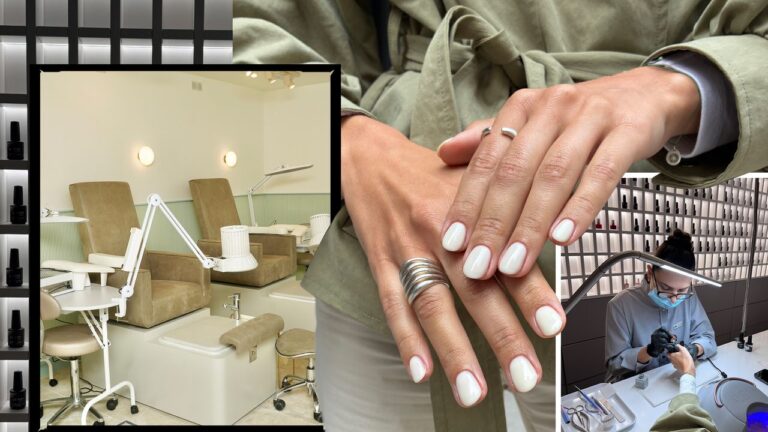
A manicure style originating in Ukraine has steadily moved from Eastern Europe to salons across the United Kingdom, the United States, and beyond. Unlike the Western approach that prioritizes nail color and design, the Ukrainian manicure treats preparation as the main event. Technicians spend roughly 40 minutes of a 75- to 105-minute appointment on cuticle care and nail shaping alone, using manual tools like files and trimmers alongside electric files. The result is durability that converts clients worldwide: manicures that last three to five weeks without chipping.
A Cultural Commitment to Grooming
In Ukraine, well-maintained nails signal personal investment across all social and economic backgrounds. Alyona Ponomarenko, beauty editor in chief of Vogue Ukraine, observes that this expectation spans professions and circumstances. “You can recognize a Ukrainian woman by her immaculate cuticles, as funny as that sounds,” Ponomarenko says. “Finding a woman with neglected hands here is surprisingly difficult. In big cities and small villages, across professions and social backgrounds, whatever her workload and however many children she has, a Ukrainian woman will almost invariably have perfectly groomed nails.”
Ponomarenko describes seeing this standard everywhere: a drone factory worker wearing a cat-eye manicure, a DIY store cashier sporting extra-long tips with a sophisticated design, and a florist whose gel manicure stays polished even when she works with soil. Even elderly women living on the margins of society frequently maintain a pearlescent finish on their nails.
Vlada Klym, founder of Browchuk salon in London, traces this to how women in Ukraine learn beauty practices across generations. “From a young age, women [in Ukraine] grow up watching and learning from one another how to take care of themselves—from nails and hair to skin care,” Klym says. “There has always been a strong desire to look and feel your best.” Viktoria Kolodii, founder and creative director of the MVK salon group which started in Kyiv, emphasizes that while color matters, the preparation itself is what resonates most. “Women want their hands to look groomed: clean cuticles, everything neat and even,” Kolodii tells Allure. “I’d say it’s a part of our culture now, to have nice neat nails and take that time for yourself—a rare self-care moment we get being so busy with everything that is going on around us.”
Manicures as Resilience During War
Since Russia’s full-scale invasion in February 2022, manicures have taken on heightened significance for Ukrainians. With air-raid alarms sounding as many as 14 times daily and residents sheltering in underground parking garages and metro stations at night, nail care has emerged as one of the few aspects of daily life women can actively control. Manicures have remained among the most in-demand beauty services in Ukraine throughout the ongoing conflict.
Ukraine’s beauty industry responded with remarkable adaptability. Salon owners made difficult decisions to relocate staff and reopen locations in safer areas, driven by economic necessity and patriotic responsibility. When Lera Borodina, founder of the salon chain G.Bar, restructured her operations after the invasion, her team of 250 to 270 people in Kyiv was redistributed to locations in western Ukraine, Poland, Georgia, and Cyprus. In Ivano-Frankivsk, where Ponomarenko and her family evacuated, salons reopened within a week.
Continuing Through Blackouts
Nail technicians worked by headlamp during missile attacks and blackouts—images that circulated globally. “There is no exaggeration here—this is simply our reality: when faced with any unclear situation, a Ukrainian woman gets a manicure,” Ponomarenko explains. Today, Ukrainian salons have evolved to ensure continuity. “Salons across the country have installed inverters and generators so they can operate independently of power cuts,” Ponomarenko says. This infrastructure allows salons to run autoclaves for sterilizing instruments, power electric nail equipment, and maintain consistent service.
How the Technique Works
The Ukrainian manicure technique evolved as gel systems became standard. In earlier decades, technicians used manual tools exclusively—emory boards and metal cuticle trimmers. As hard gels and colored gel polishes arrived, electric files became essential for removal. Kolodii explains: “The longer you wear gel, the harder it is to remove, and it takes time. So technicians started using e-files to remove it. After that, people stopped doing the wet manicure—soaking the nails in water during the treatment—and moved to combined techniques.”
Today’s service combines manual and electric tools with specific precision methods. According to Allure’s recent documentation of a Ukrainian manicure at Browchuk London, each nail is flipped upside down before curing to ensure an even, curved apex—the shape of the nail viewed from the side. This three-dimensional attention is standard across salons like So.Shell in London and MVK in New York City.
Gel Brands and Application
Gel systems typically use rubberized or builder gel formulas to reinforce natural nails. MVK in the US uses OPI and Luxio, while Browchuk London stocks these brands alongside Ukrainian companies: Touch, Gémely, LunaMoon, Dark by Rior, and Trendy Nails. So.Shell London uses LunaMoon and Komilfo. Application involves a base coat cured first, followed by the chosen color applied and sculpted with a fine detailing brush. After curing and refinement with a nail file, the service finishes with oil and cream. The entire appointment takes 75 to 105 minutes on average.
Longevity as the Payoff
The durability of a Ukrainian manicure stems directly from meticulous prep work. Klym notes that “the laser focus on cleaning up the cuticles, prepping the nails, and carefully applying the polish is what helps it to last.” According to Allure, a manicure from MVK in New York lasted four weeks without chipping. Allure content director Sophia Panych recalls a manicure from Say No Mo salon in Kyiv that lasted three weeks, with the potential for another week; a subsequent appointment in London also lasted three to four weeks. Properly executed Ukrainian manicures can remain chip-free for up to five weeks.
Global Expansion After 2022
The worldwide availability of Ukrainian manicures expanded dramatically after the invasion. Many Ukrainians who fled were already beauty professionals or trained in their new countries, bringing their manicure standards with them. Others became demanding clients, pushing local salons to meet home country expectations.
Initially, Ukrainian salon operators discovered that Western clients did not prioritize prep work in the same way. Kolodii recalls that clients in other European countries focused on color and design. “Often [the nail prep] didn’t matter much, and the focus was on color,” she says. In Germany, for example, clients spent more on pedicures than manicures, making it difficult to justify the extra investment in Ukrainian-style preparation.
Over time, the quality and lasting results attracted local clients. Kateryna Bondarenko, godaughter of Ponomarenko, opened Perle salon in Vienna, Austria; in its first weeks, the team worked 8 a.m. to 9 p.m. seven days a week to meet local demand. In London, So.Shell and Pied-de-Poule expanded since opening in 2022. So.Shell opened in December 2022 off Carnaby Street, staffed by Ukrainian refugees. Today, 95 percent of the So.Shell team is from Ukraine, with more than 100 members having arrived after the start of the war. The salon runs its own academy, training both Ukrainian and British nail technicians.
In the United States, expansion presented different challenges. G.Bar opened its Los Angeles location in 2020. MVK opened its first American salon in New York City this year, marking the brand’s first location outside Europe. Kolodii acknowledges the difficulty: “I won’t sugarcoat it, this whole experience has been very hard,” she says. “We made many mistakes and learned from them, but it was a real educational moment for us.” Language and pricing differences complicated the launch. In Ukraine, a manicure means cuticle work and shaping with no color. In the United States, clients expect manicures to include color. Ukrainian salons traditionally charge separately for each element, while American salons bundle them into one price.
Source: Allure
Frequently Asked Questions
How long does a Ukrainian manicure take?
Between 75 and 105 minutes on average, with approximately 40 minutes dedicated solely to nail and cuticle preparation using manual and electric tools.
How long does a Ukrainian manicure last?
Properly executed Ukrainian manicures typically last three to five weeks without chipping, depending on the quality of the nail preparation and gel application.
What gel brands do Ukrainian salons use?
Salons use international brands like OPI and Luxio, plus Ukrainian companies including Touch, Gémely, LunaMoon, Dark by Rior, Trendy Nails, and Komilfo.
