
Key takeaways
- Visible improvements in hydration and texture appear within 2–4 weeks, with fine line softening and firmness gains visible after 12 weeks of consistent use.
- Growth factors and peptides rebuild collagen and elastin; hyaluronic acid and ceramides restore hydration and barrier function.
- Melasyl and stabilized vitamin C target dark spots and discoloration through different mechanisms; bakuchiol and retinol smooth fine lines without irritation.
- Texture and sensory feel determine whether people stick with a serum long-term, making absorption speed and finish equally important as active ingredients.
Serums concentrate potent actives into lightweight formulas that target multiple signs of aging simultaneously—something creams cannot do as efficiently. Unlike thicker moisturizers, serums deliver their active ingredients deeper into the skin without the barrier of occlusive emollients. According to Dr. Mona Foad, a board-certified dermatologist in Cincinnati, the timeline for results is predictable: “With consistent use, many patients begin to notice improvements in hydration and skin texture within about two to four weeks. More visible changes, such as smoother fine lines, improved firmness, and a more even tone, typically develop after 12 weeks as collagen production increases.” The catch is that consistency matters. Missing applications or skipping sunscreen undoes the gains these serums deliver.
Growth Factors and Peptides: Rebuilding Structural Support
When dermatologists recommend serums for sagging and loss of firmness, SkinMedica’s TNS Advanced+ Serum appears on nearly every list. The serum’s hero ingredient—TNS, or tissue nutrient solution—is a concentrated blend of growth factors that address sagging, cytokines that trigger cellular repair, antioxidants, and matrix proteins. Three botanicals boost the effect: French flaxseed, marine extract, and green microalgae work synergistically to support collagen production and slow visible aging. Dr. Heidi Prather, a board-certified dermatologist in Austin, highlights a detail that determines real-world compliance: “The formulation feels silky and smooth on the skin.” Jenny Bailly, Allure’s executive beauty director, has used TNS Advanced+ consistently enough to notice the difference when she runs out. “When I use SkinMedica TNS Advanced+ Serum regularly, I get not-infrequent compliments on my skin. When I run out—which I really try to avoid—they start to dry up,” she reports. SkinMedica recently redesigned the original dual-chamber bottle into a sleeker version that eliminates the pumping issues Bailly once experienced.
Peptide-Based Lifting Without Growth Factors
SkinCeuticals’ P-Tiox pursues firmness through signal peptides—molecules that instruct skin cells to perform specific functions. These peptides soften glabella 11s (the vertical lines between the brows), cheek folds, and forehead creases while imparting a plump finish. A hydrating complex of sea kelp extract provides antioxidant protection and preserves collagen stores. The serum also contains 5% polyhydroxy acid (for gentle exfoliation), 5% niacinamide (for brightening), and 1% laminaria extract—a humectant from brown algae. Dr. Rachel Westbay, a board-certified dermatologist in New York City, explains the synergy: “The combination of these hydrators with the peptides can lessen the appearance of prominent pores and improve overall skin quality and smoothness.” Jessica Cruel, Allure’s editor in chief, values P-Tiox specifically for smile lines. “As someone who loves to laugh, I am particularly concerned about my nasolabial folds,” she says. “I use this serum so they don’t get any worse. I have to say, I find my filler lasts a lot longer in that area.”
Strength-Building with Lab-Engineered Peptides
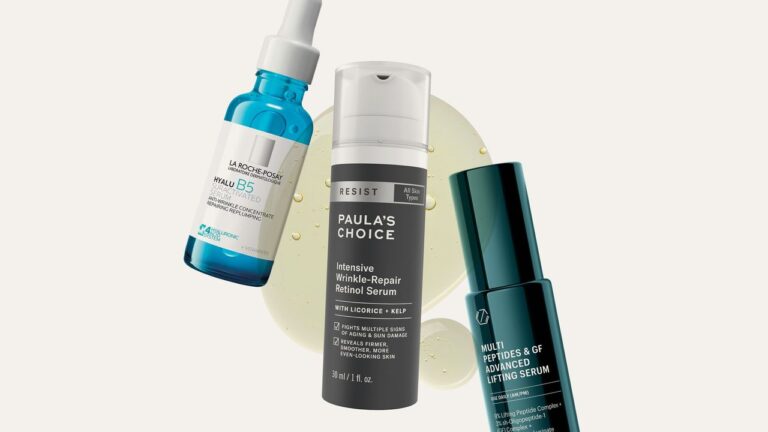
Allies of Skin’s Multi Peptides & GF Advanced Lifting Serum concentrates the approach with a 9% lifting peptide complex and 3% SH-oligopeptide-1, a lab-engineered growth factor that signals cells to support collagen and elastin repair. Copper lysinate/prolinate—combining copper with the amino acids lysine and proline—adds another line of support for firmness, while MSM, a sulfur-rich compound, maintains elasticity. The serum is non-comedogenic and includes Centella asiatica for soothing and antioxidant benefits. Sarah Han, a commerce editor, noticed the effect immediately. “The serious and immediate glow I get from this ultra-silky Allies of Skin serum alone was enough to sell me on it,” she reports. “The serum sinks into my skin immediately and provides a slight gripping effect that’s perfect for makeup—an unexpected bonus, but I’ll absolutely take it.”
Erasing Dark Spots and Evening Tone
Years of cumulative UV damage lead many people to develop hyperpigmentation and dark spots. The L’Oréal Paris Revitalift Triple Power Melasyl Dark Spot Creamy Serum tackles this through a proprietary molecule called Melasyl. Dr. Dawn Queen, a board-certified dermatologist in New York City, explains the mechanism: “Melasyl works differently from many traditional ingredients by intercepting excess melanin precursors before they develop into dark pigment.” Brightening vitamin C and niacinamide accompany Melasyl to even tone, plus glycerin for hydration. “The creamy texture also makes this a pleasant, more substantial serum for mature skin that may feel drier,” Dr. Queen adds.
Vitamin C Alternatives for Sensitive Skin
Avène’s Vitamin Activ Cg Radiance Serum pairs vitamin Cg—a stabilized form equivalent to 20% vitamin C—with bakuchiol, a plant-derived retinol alternative that smooths fine lines and improves firmness without the irritation traditional retinoids sometimes cause. Niacinamide brightens discoloration, while the brand’s Thermal Spring Water, glycerin, and sodium hyaluronate replenish moisture. Dr. Jane Yoo, a dual board-certified dermatologist in New York City, recommends it specifically for those seeking brightness without tolerance issues: “This is the type of formula I reach for when someone wants brightening but cannot tolerate a traditional vitamin C serum with L-ascorbic acid.” The serum does contain added fragrance, so those with reactive skin should patch test first.
Hydration: The Foundation for Visible Improvement
Fine lines look sharper when skin is dry, which is why mature skin often responds visibly to deep hydration. La Roche-Posay’s Hyalu B5 Pure Hyaluronic Acid Serum delivers this with hyaluronic acid to plump skin and soften fine lines, vitamin B5 to support repair and resilience, and madecassosides—wound-healing compounds from Centella asiatica—that nourish the barrier and soothe irritation. The formula is allergy-tested and gentle enough for sensitive skin, crucial because the skin barrier becomes more reactive with age. Dr. Christina Sun, a board-certified dermatologist in Philadelphia, notes that “hyaluronic acid helps improve elasticity and volume.” Sarah Hoffmann, a commerce market editor, uses hyaluronic acid serums to address multiple concerns: “There are few skin issues in my life that a good hyaluronic acid serum can’t fix. Dry patches? Hyaluronic acid. Dull skin? Hyaluronic acid. Clogged pores? Hyaluronic acid genuinely helps balance my skin so it doesn’t produce the excess oil that irritates my pores.” She values La Roche-Posay’s medium viscosity and non-sticky feel, layering it under moisturizer.
Hydration Plus Structural Support
Alastin’s Restorative Skin Complex with TriHex+ serves those with deeper wrinkles and significant dryness. The serum’s TriHex+ Technology—a blend of peptides and botanicals—clears damaged proteins in the skin’s extracellular matrix while supporting fresh collagen and elastin production. A recent reformulation added octapeptide-45 to boost collagen, elastin, and hyaluronic acid synthesis, magnolol to restore depleted volume, and L-ornithine to firm and plump thinning skin. Dr. Queen describes the texture: “It’s silky and lightweight, but with a more substantial feel that works well for people with mature skin and deeper structural issues.” Christa Joanna Lee, a contributing commerce writer with dry, sensitive skin and deeper wrinkles, relies on it as a serum-moisturizer hybrid. “I’ve used it on and off for about a year now, and I can always tell when it’s missing from my routine: My skin looks duller, less plump, and generally more tired-looking.”
The Retinol Standard and All-in-One Alternatives
Paula’s Choice Intensive Wrinkle-Repair Retinol Serum holds a long-standing place in dermatologist routines. The stabilized 0.1% retinol sits at a sweet spot for users ready to advance from milder formulations. Vitamins C and E accompany the retinol—a pairing that preserves formula stability and boosts effectiveness. Dr. Michelle Henry, a board-certified dermatologist in New York City, explains: “Compounding vitamin C with another antioxidant like vitamin E preserves the stability and boosts the effectiveness of the serum,” delivering more noticeable smoothing of deeper-set lines.
CeraVe’s Skin Renewing Super Boost Serum addresses fine lines, firmness, brightness, and hydration without requiring multiple products. Hyaluronic acid hydrates, peptides smooth, niacinamide brightens, and LHA provides gentle exfoliation, while vitamin B12 adds color. Three essential ceramides paired with CeraVe’s proprietary Ceramide Booster Technology encourage the skin’s own ceramide production for better moisture retention. Dr. Queen notes that the formula addresses aging while supporting the barrier: “As skin matures, it becomes drier and more sensitive as the skin barrier loses strength, so this serum is ideal.” The lightweight, milky texture absorbs quickly without greasiness, supporting regular use.
Frequently Asked Questions
How long does it take to see results from aging serums?
According to Dr. Mona Foad, hydration and skin texture improvements appear within 2–4 weeks of consistent use. More visible changes—smoother fine lines, improved firmness, and even tone—typically develop after 12 weeks as collagen production increases.
What ingredient should I choose if I have dark spots?
Melasyl, found in the L'Oréal Paris Revitalift Triple Power Melasyl Dark Spot Creamy Serum, intercepts melanin precursors before they develop into pigment. Stabilized vitamin C, as in Avène's Vitamin Activ Cg Radiance Serum, also brightens discoloration and is gentler for sensitive skin.
Can I use a serum instead of a retinoid if I have sensitive skin?
Yes. Bakuchiol, a plant-derived retinol alternative in Avène's Vitamin Activ Cg Radiance Serum, smooths fine lines and improves firmness without the irritation traditional retinoids can cause. Peptide-based serums like SkinCeuticals' P-Tiox offer another gentler path to firmness.
