
Key takeaways
- Lili Reinhart wore two custom wigs instead of dyeing her hair, designed by Stacey Butterworth and color-matched to a bronde shade between dark blonde and light brown.
- Frédéric Bélanger styled Olive's hair to reflect her character as an overwhelmed student, keeping it unstyled in casual moments and lightly styled for social events.
- Tom Bateman's grooming evolves throughout the film to mirror his character's emotional arc, with stiffer hair at the start loosening as Dr. Carlsen becomes warmer.
- The film's first kiss scene recreates the chignon from The Love Hypothesis book cover, which was inspired by Star Wars characters and Adam Driver's appearance.
When Lili Reinhart was cast as Olive Smith in the film adaptation of Ali Hazelwood’s The Love Hypothesis, attention quickly turned to her appearance. For six years, Reinhart had been golden-blonde Betty Cooper on Riverdale. Her announcement in July as a darker-haired protagonist surprised fans, though reactions were largely positive. Still, expectations were immediate: readers had formed precise images of how Olive should look.
Achieving that vision required more than wardrobe and makeup. It required the precision of Frédéric Bélanger, the film’s hair department head, working alongside wigmaker Stacey Butterworth. Bélanger understood the weight of visual storytelling in adaptations. “Everybody has a picture in their head,” he notes of how audiences imagine characters before seeing them on screen.
Wig Selection and Construction
Choosing the Right Shade
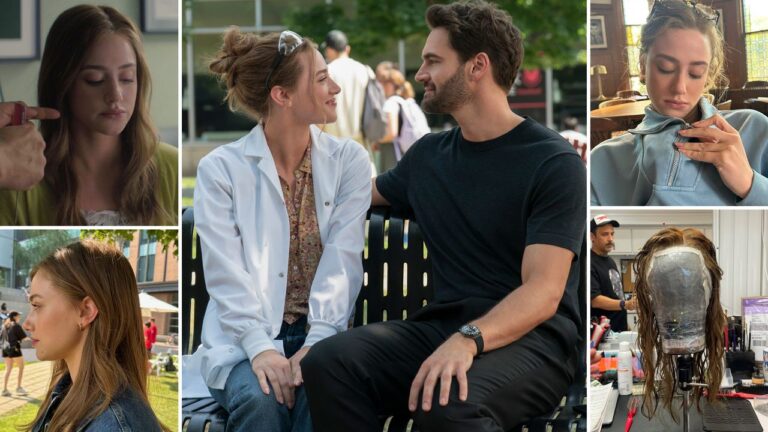
Reinhart did not dye her hair for the role. Instead, Bélanger and Butterworth created two wigs. The book’s cover offered a starting reference: a red or warm brown tone. That exact shade was tested, along with honey and chestnut variations. After evaluating the options, the team landed on what Bélanger describes as “somewhere between dark blonde and light brown”—what the beauty world calls bronde. The specificity mattered. Too dark and the color would feel shocking. Too light and audiences might not register it as truly brunette. Calibration had to be precise.
Installation and Texture
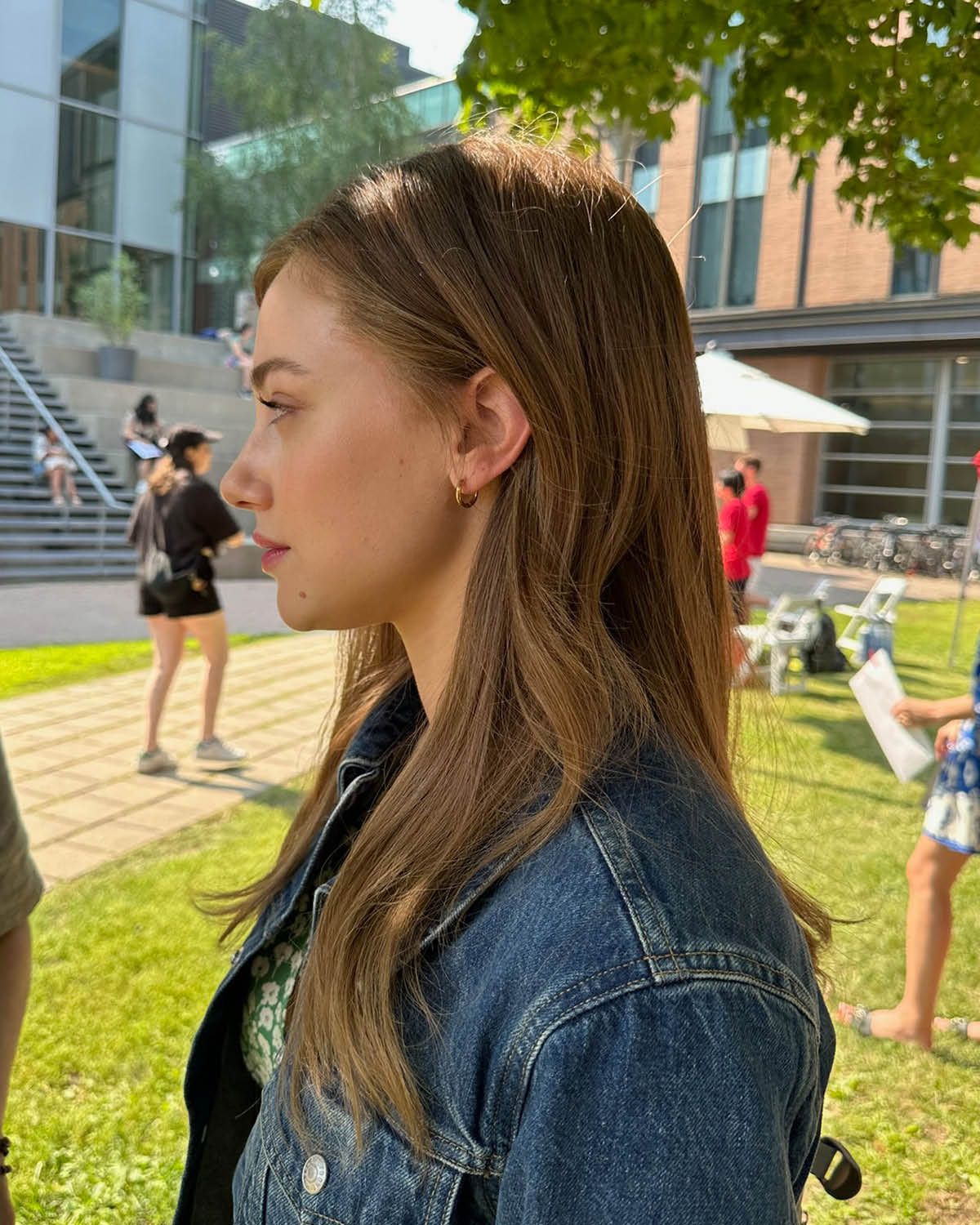
Once the shade was selected, Butterworth began construction. She molded Reinhart’s head before installing hair “strand by strand” into the base. That meticulous process reflected the stakes: audiences scrutinize wigs looking for tells. After fitting the wig on Reinhart, Bélanger and Butterworth added different-colored strands throughout for depth and visual complexity that real hair naturally carries. They also threaded in lightweight, fluffy strands that would catch air and move the way natural hair behaves outside on warm, humid days, and in the scenes calling for that freedom—such as watching someone play ultimate Frisbee.
Making It Convincing On Camera
Creating a convincing wig on film required attention to minute details. “We had to think about the hairline, the density—all the details that will make a difference,” Bélanger says. “Sometimes it can look wig-y.” The hairline, where scalp meets hair, can immediately reveal a wig. The density—how closely packed the strands sit—had to read as human. The choice to add varied tones and lighter strands wasn’t decorative; it was about how light falls on hair and how it moves. These decisions translate directly to what audiences perceive as real or synthetic.
Securing and Concealing
Fitting the wigs over Reinhart’s thick hair presented a logistical challenge. “I had to really work it precisely so that it disappeared,” Bélanger recalls. The solution required pulling her hair underneath the wig base “very, very, very tight,” though he balanced tension against discomfort. The tightness sometimes tugged at the edges of her face. Reinhart responded with humor: “She would be like, ‘Fred, you’re giving me a facelift. People will think I have a facelift,'” Bélanger remembers, laughing. He eventually loosened the grip. Her comfort and natural appearance mattered more than maximum security.
Once the wig was pinned in place with U-shaped pins, Bélanger used Kryolan Dermacolor Camouflage Creme to blend where Reinhart’s scalp met the wig’s base. The creme was color-matched to her actual scalp, eliminating any visible line between her skin and the hairpiece. Every visible seam had to disappear.
Hair as Character Development
Olive’s Lived-In Look
How Olive’s hair appeared was never incidental to the character. She is a STEM student spending significant time in the library—not a character whose life permits perfect hair. Bélanger treated the styling as narrative. “Olive is not the perfect girl. She’s a student. Students are overwhelmed. We wanted the hair to look like it could be lived in,” he explains. The goal was believability rooted in character reality, not aesthetics divorced from context. Everything onscreen had to serve the logic of who Olive is.
Scene-Specific Styling
This philosophy shaped how the hair appeared in different moments. When Olive watches Love Island with her best friend Anne, sitting on a couch in pajamas with popcorn and chocolate, her hair is unstyled and fresh from washing. “You’re in pajamas with your best friend eating popcorn and chocolate,” Bélanger observes. In that moment between confidantes, nobody cares about polish. “We worked the hair in a way that it would intentionally look like she did it herself,” he continues. The styling was deliberate restraint.
By contrast, when Olive attends a party in a red dress, her hair is styled—though not luxuriously. Bélanger imagines the narrative: perhaps she didn’t visit a salon because her student schedule didn’t allow. Perhaps her friend Anne styled it for her. Everything carries internal logic. The styling choices suggest resourcefulness and pragmatism, someone solving the problem of her appearance with what she has at hand.
Surrounding Choices
Tom Bateman, who plays Dr. Adam Carlsen, undergoes a grooming arc of his own. His character begins the film as “Dr. Evil” to his students, a stiff, controlled persona. As the story progresses and he softens emotionally, his grooming shifts visibly. Early on, his hair appears stiffer. As warmth enters his character, his hair relaxes. “You really see the progression of him loosening up and being more willing to be warmer. The hair translated that,” Bélanger says.
The novel originated as fanfiction inspired by Star Wars’ Kylo Ren and Rey, played by Adam Driver and Daisy Ridley. This origin influenced film visual choices. “They created these characters thinking of these two other characters, so it had a repercussion in our decisions,” Bélanger notes. One decision involved Bateman’s facial hair. The novel’s cover, inspired by Driver’s likeness, shows the male lead without a beard. Yet Bélanger questioned this choice directly: “Is it going to be the best look for him?” The reasoning: audiences should relate to the character on his own terms, not as a recreation of another actor.
Daisy Ridley, who is married to Bateman in real life, became relevant in another way. The production attempted to arrange a cameo appearance for her, however small, as an easter egg for fans aware of the novel’s origins. The arrangement ultimately fell through, though the attempt reveals how thoroughly the filmmakers engaged with the source material’s layered identity.
The climactic moment of the novel and its most iconic image is Olive and Adam’s first kiss. Bélanger designed the hair for this scene with particular care about fidelity to the source. He created a chignon—an upswept style—with a silhouette that echoed the book’s cover, woven like a bow. The scene was shot from multiple angles and positions, each requiring the hair to maintain the exact silhouette. Bélanger understood what was at stake: “The cover of the book is how you enter a story.” Making the hair right in that moment honored both the visual promise readers received and the emotional weight of the scene itself.
Frequently Asked Questions
Did Lili Reinhart dye her hair for The Love Hypothesis?
No. Frédéric Bélanger and Stacey Butterworth created two custom wigs for Reinhart, color-matched to a bronde shade that sits between dark blonde and light brown, tested against red/warm brown and chestnut options from the novel's cover.
How did they make the wigs look realistic on camera?
The team added different-colored strands throughout for dimension and lightweight, fluffy strands that moved naturally in heat and humidity. Bélanger paid close attention to the hairline, density, and scalp blending using Kryolan Dermacolor Camouflage Creme color-matched to Reinhart's skin.
Did Daisy Ridley appear in the film as a cameo?
No, though the production attempted to arrange a small cameo for her as an easter egg for fans aware of the novel's Star Wars fanfiction origins. The arrangement did not ultimately work out.
