
Key takeaways
- The Airsmooth's flexible AntiSnag and PivotFlex bristles reduce breakage and work on different hair types without excessive heat.
- Performance peaks on type 2 waves and type 3 curls; coily hair gets fluffy results, fine hair may need a curling iron for ultra-sleek looks.
- At $250, the standalone tool works worldwide with an adapter, unlike the region-specific Airwrap, making it better for frequent travelers.
- Testers with coily hair reported faster drying and cleaner results compared to other hot tools, cutting styling time significantly.
Dyson’s latest addition to its hot-tool lineup landed earlier this month: the Airsmooth Styling Dryer Brush. This standalone device moves damp hair to dry without the bulk of the brand’s flagship Airwrap, and at $250, it positions itself between a basic blow-dryer and the full Airwrap system. The immediate question wasn’t just whether it works, but for whom.
The pre-launch reception was mixed. Dyson demonstrated the tool on tight curls, and the response was lukewarm at best. That hesitation is worth unpacking. Dyson had already created brush attachments for the Airwrap, so why release a separate product? More pressingly, would a brand with a history of designing primarily for straighter hair types finally deliver something that works for textured hair?
According to Kavya Nair, a Dyson design manager based in Singapore, the team saw an opening to address a persistent complaint among textured-hair users. “One of the key things that we wanted to solve is the fact that our products essentially weren’t giving the performance that a lot of 3T and 4T users desired,” Nair explains. The goal wasn’t to replicate the Airwrap in brush form. Rather, it was to engineer something that could satisfy people with genuinely different hair needs while remaining portable.
The Bristles Tell the Story
The Airsmooth looks simple enough: a teardrop-shaped brush head with a narrow edge for root access and flat sides for styling. But the most important difference is in the bristles themselves. Dyson ditched the ball-tipped ends that dominate most hot brushes and instead engineered two distinct bristle types: AntiSnag and PivotFlex.
Why Ball Tips Don’t Work for Every Hair Type
Nair’s team discovered a persistent complaint among users, particularly those with fine or coily hair: breakage and scalp discomfort. The culprit was the ball-tipped bristle design. Rather than gliding through knots, those tips catch and tear them, making the styling experience painful and damaging. “The bristles tend to catch knots and tear them, as opposed to working through them,” Nair notes.
The challenge, though, was balancing two opposing needs. Coily and curly-haired users want high tension for control, but fine-haired users find tension uncomfortable on the scalp. “If you design something very high in tension, the curly/coily community loves it,” Nair explains. “But the minute you do that, users with finer hair say, ‘It’s painful for me, I need this to be more flexible.’” The solution required bristles that could offer both.
How AntiSnag and PivotFlex Work
The AntiSnag bristles feature a looped structure that flexes and releases knots rather than snagging them. The PivotFlex bristles take this further: thinner and more flexible, they bend up to 90 degrees and adapt to your hair type to release tangles without force. These bristles also use an open-base design that diffuses airflow and minimizes frizz. Together, they’re designed to move through wet hair with less resistance and less potential for damage.
Airsmooth Versus Airwrap: What You’re Actually Trading
The Airwrap includes two brush heads alongside multiple other attachments. It’s marketed as a “salon in a box” and comes with versatility built in. The Airsmooth is intentionally simpler: one tool, one job, designed to be portable and accessible to anyone who travels or doesn’t want to invest in Dyson’s pricier ecosystem.
Nair frames the difference clearly: where the Airwrap demands region-specific voltage (meaning your North American unit won’t function in Europe), the Airsmooth runs on lower power and works worldwide with a plug adapter. For frequent international travelers, that alone makes a difference. The Airsmooth also arrives without the investment and learning curve of managing multiple attachment heads. “I like to call the Airwrap a salon in a box,” Nair says, while the Airsmooth offers “wet-to-dry styling capability that people can take with them on the go.”
That simplicity comes with a trade-off: less versatility. You get one brush, not interchangeable heads for different effects. Whether that’s a fair exchange depends entirely on what you need.
Performance Varies by Hair Type
Any universal styling tool will perform on a bell curve. Matt Collins, a Los Angeles-based hairstylist and global styling ambassador for Dyson, noted that the Airsmooth hits its stride with type 2 waves and type 3 curls with thicker hair. “I really noticed the super-smooth blowout with not much work, and they were getting this beautiful flip and bounciness,” Collins says of that middle range.
Coily Hair Gets Fluffy, Not Sleek
For coily hair, a silk press isn’t realistic, but Cataanda James, a New York City-based hairstylist, points out that type 4 users “could be successful in using this brush and getting a nice fluffy blowout,” especially working in small sections with the right products. The term “fluffy blowout” recurs often. It’s not sleek or stretched, but it’s more defined and voluminous than unblown hair.
Fine Hair Needs a Different Approach
Fine and thin hair presents another story. Collins acknowledges these hair types “are not going to get the most incredible blow-dry flip,” but he also notes that achieving that flip with fine hair requires extensive work regardless of the tool. Carlyn Griscti, another New York City hairstylist, suggests skipping blow-dry brushes entirely if your goal is a supermodel blowout on fine hair. Her alternative: rough-dry your hair and finish with a large-barrel curling iron.
Testing Across Four Hair Types
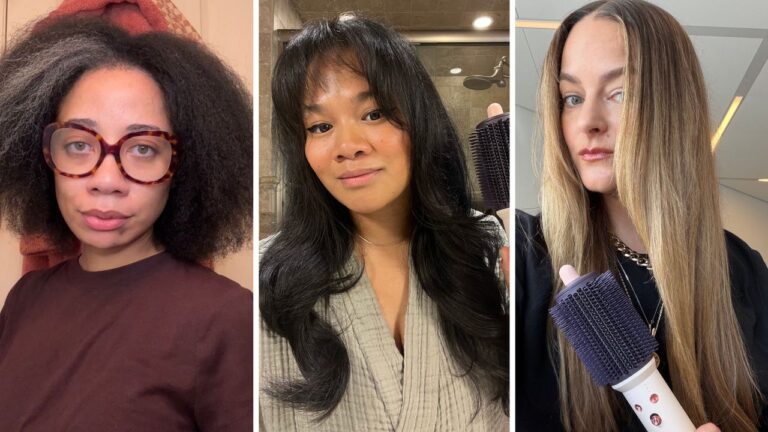
Eden Stuart, who has 4a to 4c coily hair, entered the test expecting disappointment. No blow-dry brush, she assumed, would deliver a silk press for textured hair. Instead, she found it “makes a significant difference in the first step toward a sleek finish” and can produce a cute blowout without the second pass under a flat iron, something she usually requires. She valued that it dried her roots quickly without excessive heat, even at the highest temperature setting. The result wasn’t a polished finish in one step, but the time savings and smoothness were enough that she’d spend the $250.
Jessica Cruel, testing the Airsmooth for the first time as a type 4 user prone to shrinkage, prepared her damp hair with Kenra Professional Thermal Styling Spray and used the FHI Heat Unbrush to detangle before moving to the Airsmooth. She found the brush produced fluffier, more voluminous results than her usual Dyson Airwrap comb attachment, though the process still took 45 minutes to an hour. The tool delivered the tension needed for smoothing coily hair, though she worried about pulling too hard on her finer strands.
Sophia Panych, with long, fine, wavy hair prone to tangles and knots, typically avoids hot brushes because bristles snag along the way. She was surprised by how easily the Airsmooth combed through her damp hair at a press preview. Testing it at home, she achieved a sleek blowout in under 10 minutes, though she notes she got zero bounce, which aligns with expectations for fine hair. She valued the narrow edge for root access and the ability to add a subtle bend at the ends with the wider side. One caveat: hair collected on the brush afterward, though she couldn’t determine if that was normal shedding or related to how easily the bristles move through strands.
Jesa Marie Calaor, with thick, naturally wavy hair that holds shape easily, typically doesn’t reach for hot-air brushes because they create an in-between effect: neither retaining her waves nor delivering the bouncy, polished look she prefers. Testing the Airsmooth, she prepped her damp hair with Cecred Moisture Sealing Lotion, sectioned it into three parts, and set the tool to its highest setting. The teardrop shape and flexible bristles made it easy to grip near the roots and create tension for smoothing. Like Stuart, she appreciated that the heat never felt excessive.
Worth the Investment
The Dyson Airsmooth isn’t a universal solution. It performs best on mid-range hair types: those with waves and loose curls that respond well to heat styling. For people with extremely fine hair seeking a supermodel blowout or those with coily hair expecting a sleek result, manage expectations. But for anyone in the middle range, frequent travelers, or stylists seeking a portable tool that doesn’t sacrifice performance, the $250 price lands closer to reasonable than it might first appear.
Frequently Asked Questions
What makes the Airsmooth different from other blow-dry brushes?
Dyson replaced ball-tipped bristles with AntiSnag and PivotFlex bristles. AntiSnag bristles have a looped structure that flexes and releases knots; PivotFlex bristles bend up to 90 degrees and adapt to different hair types. The open-base design also diffuses airflow to minimize frizz.
Who should buy the Airsmooth?
It works best for type 2 waves and type 3 curls with thicker hair, producing bouncy blowouts with minimal effort. Type 4 coily hair can achieve fluffy results, especially working in small sections with the right products. Fine hair may be better served with alternative tools like a large-barrel curling iron.
Does the Airsmooth work outside North America?
Yes. Unlike the Airwrap, which requires region-specific voltage, the Airsmooth operates on lower power and works worldwide with an appropriate plug adapter.
