
Key takeaways
- Topical wrinkle fillers use hydration, peptides, and growth factors to plump skin and reduce fine lines, delivering temporary results that complement but don't replace injectable procedures.
- Products vary by mechanism—hydration-first serums work instantly, peptide complexes build firmness over time, and growth-factor formulas support collagen production through cellular signaling.
- Start using wrinkle fillers in your mid-20s when collagen begins declining, or prioritize a protective routine with sunscreen, retinol, and antioxidants if fine lines aren't yet a concern.
Wrinkle fillers—the topical kind, not the injectables you’d receive at a dermatologist’s office—promise to smooth fine lines and restore a plump, youthful appearance to aging skin. But what exactly are they, and do they actually work?
These serums and treatments are formulated to temporarily fill in wrinkles by attracting water to the skin and trapping it there, according to Margarita Lolis, MD, a board-certified dermatologist in Hackensack, New Jersey. The hydration this creates gives skin an immediate boost, making it look fuller and more refreshed. Some formulations go further, incorporating retinoids like prescription-strength tretinoin or over-the-counter retinol to stimulate collagen production and restore volume over time.
The reality check: these products deliver temporary results. Moisturizers and serums “can only do so much,” Dr. Lolis explains, “and they definitely cannot deliver the same taut or super-smooth look that an in-office procedure can.” Still, for those seeking a non-invasive way to address fine lines and dullness, wrinkle fillers offer an accessible option.
When to Start Using Wrinkle Fillers
The timeline for introducing these serums into your routine depends on your skin’s current state and goals. Collagen production naturally declines by roughly 1% every year beginning in your mid-20s, according to Martha Viera, MD, a board-certified dermatologist based in Coral Gables, Florida. This makes the mid-20s an ideal age to begin incorporating wrinkle fillers if you’re interested in being proactive.
However, preventive measures matter first. “If fine lines and wrinkles aren’t yet a concern, there’s no need to rush into using wrinkle fillers,” Dr. Viera says. Instead, she recommends building a foundational routine that includes sunscreen, moisturizers, antioxidants, and retinol to keep skin protected and healthy for the long term.
Hydration-Driven Serums
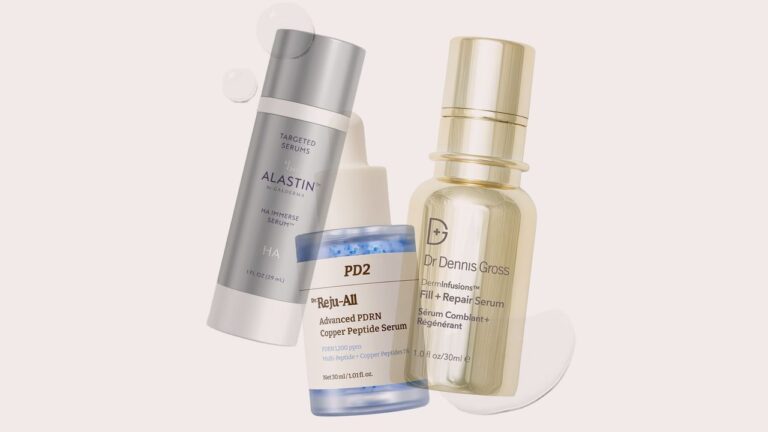
Alastin HA Immerse Serum
Alastin’s HA Immerse Serum distinguishes itself from standard hyaluronic acid products through a two-pronged hydration strategy. The formula combines sodium hyaluronate (a stabilized form of hyaluronic acid) with crosslinked hyaluronic acid to bind water directly to the skin. The result, according to Dr. Viera, is “an immediate refreshing and plumping effect.”
Beyond immediate hydration, the serum aims to sustain plumpness over time. The brand’s proprietary octapeptide-45 works to encourage the skin’s natural production of high-molecular-weight hyaluronic acid—the type that maintains hydration in the skin’s outermost layers—while hexapeptide-11 helps inhibit the enzymes responsible for breaking down hyaluronic acid. Silver mushroom extract, glycerin, and betaine layer in additional moisture, helping both age-related and dehydration-triggered lines appear softer.
Isdin Instant Flash Firming and Lifting Serum Ampoules
These single-use ampoules concentrate peptide Q10—a peptide paired with coenzyme Q10, an antioxidant the skin naturally produces but loses with age—into a potent formula. Together, the combination targets firmness while smoothing fine lines and restoring radiance. Hyaluronic acid floods the skin with immediate hydration, creating visible plumping that works especially well when skin appears tired or dull.
Peptide-Focused Formulations
SkinCeuticals P-Tiox
Peptides take center stage in SkinCeuticals’ P-Tiox, which pairs them with 5% polyhydroxy acid, 5% niacinamide, and 1% laminaria extract. This combination zeros in on the areas where fine lines most commonly appear: cheek folds and the glabella between the brows.
The formula “glides on very smoothly,” according to Jane Yoo, MD, a dual board-certified dermatologist based in New York City, making it easy to layer other skincare products afterward. The serum delivers a plump, glassy finish while helping soften expression lines.
Medik8 Liquid Peptides Advanced MP Serum
This serum contains 13 different peptides within a 30% multi-peptide complex, each designed to visibly smooth wrinkles and improve skin texture. Two proprietary standouts are Medik8’s Growth Factor MiniProtein and Expression Line MiniProtein—lab-designed proteins engineered with specific molecular shapes and sizes to target different aging concerns.
The Expression Line MiniProtein focuses on dynamic wrinkles etched by facial movement—smiling, squinting, eyebrow raising—helping them appear less pronounced. The Growth Factor MiniProtein works gradually to support the skin’s underlying structure, delivering firmer and more supple-looking results over time. Glycerin, sodium hyaluronate, and panthenol add immediate hydration and plumping effects.
Dr.Reju-All Advanced PDRN Copper Peptide Serum
This Korean pharmacy brand focuses on PDRN (polydeoxyribonucleotide) in its Advanced PDRN Copper Peptide Serum, delivering 1,200 ppm of salmon-derived PDRN—short DNA fragments meant to support skin renewal and repair. While PDRN injections are legal outside the US and work by “basically turning on the switch to wake up the cells and hopefully get them to produce more collagen,” according to Mona Gohara, MD, a board-certified dermatologist in Hamden, Connecticut, topical PDRN operates differently. “Clinical evidence for topical PDRN serums is still emerging,” notes Cheryl Karcher, MD, a board-certified dermatologist based in New York City.
The serum compensates with structural support through a 1% multi-peptide complex that includes copper tripeptide-1 and other signaling peptides designed to support the extracellular matrix—the structural framework providing skin firmness and elasticity. Niacinamide backs up the skin barrier by supporting lipid production, while panthenol and beta-glucan soothe and help skin retain moisture. Glycerin, sodium hyaluronate, and sodium PCA deliver additional hydration for immediate plumping effects.
Growth Factor Technology
SkinMedica’s TNS Advanced+ Serum represents a Hall of Fame product that, according to Allure, added another Best of Beauty Award to its résumé in 2026. The serum’s “TNS” stands for tissue nutrient solution, a blend of growth factors and proteins produced by lab-grown human fibroblasts—the cells responsible for manufacturing collagen and elastin in skin.
These growth factors function as messengers, signaling processes involved in skin repair and collagen and elastin production. SkinMedica obtained the patent for the first cosmetic product with growth factors in 2000, and numerous clinical studies have validated the TNS approach. Blair Murphy-Rose, MD, a board-certified dermatologist, calls it “one of the most clinically supported growth-factor serums on the market,” with potential for noticeably firmer-looking skin in as little as two weeks.
The dual-chamber bottle pairs the growth factors with peptides designed to further support firmness and elasticity, plus an antioxidant blend of marine extract and green microalgae to improve tone and texture appearance. One pump dispenses both chambers simultaneously, combining them into a lightweight, fragrance-free serum. A recent bottle redesign addressed previous uneven dispensing issues, though storing the bottle upright helps as well.
Elastin-Focused Solutions
Obagi’s ElastiDerm Firming Facial Serum targets crepey skin—a condition that occurs when elastin, the stretchy structural protein keeping skin taut and springy, begins to lose its resilience. The serum’s proprietary Bi-Mineral Contour Complex combines zinc, copper, and malonate (a derivative of malonic acid) to support the three stages of healthy elastin development.
“Elastin allows the skin to stretch and bounce back,” explains Cheryl Karcher, MD, a board-certified dermatologist based in New York City. Obagi’s formula backs up this natural system, helping thin, crinkly texture look smoother while skin feels firmer and more resilient over time. Glycerin pulls in moisture for immediate plumping, and silicones create a silky, smoothed-out finish on contact.
Source: Allure
Frequently Asked Questions
How do topical wrinkle fillers work?
These serums attract water to the skin and seal it in, creating temporary plumping that smooths fine lines. Some formulas also include peptides, growth factors, or retinoids to stimulate collagen production for longer-term improvements.
What's the difference between topical and injectable wrinkle fillers?
Topical wrinkle fillers are serums delivering temporary hydration and smoothing effects. Injectable fillers, performed by dermatologists, create more permanent structural changes that topical products cannot achieve, though topical options are accessible non-invasive alternatives.
When should I start using wrinkle fillers?
You can begin incorporating wrinkle fillers in your mid-20s when collagen production starts declining at about 1% per year. However, if fine lines aren't a concern yet, prioritize sunscreen, moisturizers, antioxidants, and retinol to build a strong skincare foundation first.
